
What Is bioMind? Claude, Built Into Your Genomics Notebook
bioMind is the AI copilot in Pan.bio's Notebooks: Claude, running in your notebook. It reads your files and writes the Python and R you run, from plots to PCA.
Every genomics analysis carries a hidden tax: the gap between having a question and having the code to answer it. You know what you want, differential expression across conditions, a PCA to check batch structure, a variant filtered down to the clinically relevant set, but getting there means context-switching into Python or R, wrangling libraries, and debugging syntax that has nothing to do with the biology. For researchers who don't code, that gap is a wall. For those who do, it's a tax on time that should be spent on interpretation.
bioMind closes that gap. It's a set of specialized bioagents built into Pan.bio's Notebooks, a Jupyter-style environment for genomics and bioinformatics, and it works like a research partner that happens to write flawless code.
Three things set it apart:
1. It's Claude, the frontier model, running directly inside your notebook and grounded in bioinformatics.
2. It's connected to your file system, so it reads your data, dataframes, and outputs directly, with nothing to paste in.
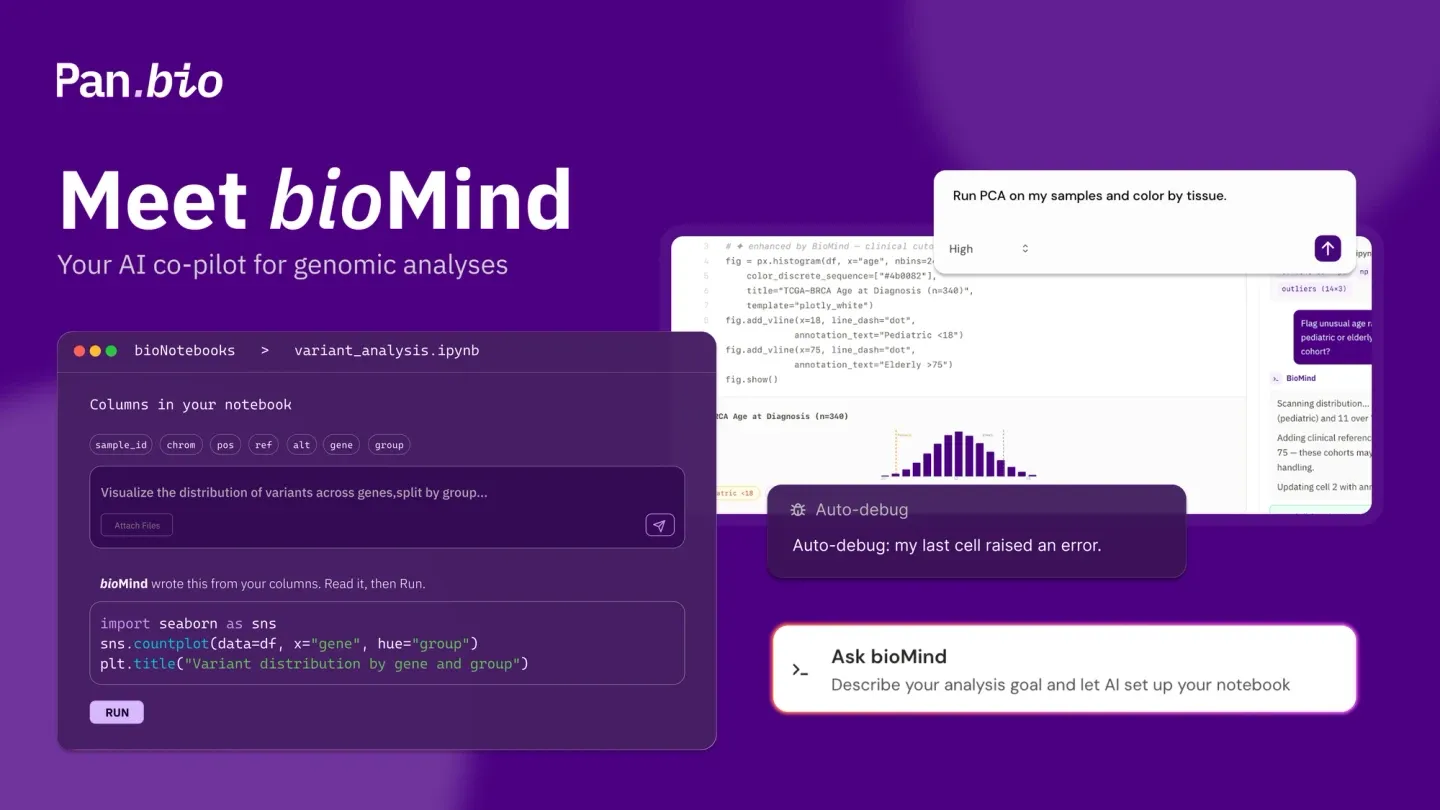
3. And it generates the analysis for you, expression matrices, PCA, heatmaps, volcano plots, all as runnable Python or R that lands in a cell and waits for your review before you press Run.
Describe the analysis in plain language; bioMind writes it, explains its reasoning, corrects itself when a cell fails, and carries the context of your work from one session to the next.
It helps to be precise about that first point. bioMind is not a separate model trained on biology. It is Claude, the same frontier model you would trust with hard reasoning anywhere else, running inside a bioinformatics environment with domain knowledge, your data, and memory of your work at hand. You get the intelligence you already rely on, situated where the science actually happens.
It's one AI across every Pan.bio product, not a collection of separate bots. bioMind powers every AI-assisted experience on the platform through the BioAgents layer: a set of domain-specialist agents, one per application. Each has its own curated knowledge and tools, but you never see that routing. Same chat, same memory, same way of working; the expertise shifts to match whatever you're doing.
What bioMind does
bioMind is multi-agent by design. One domain-specialist agent per Pan.bio application, sharing the same memory and skills. You just talk to bioMind; the routing stays out of sight.
Here is what it does:
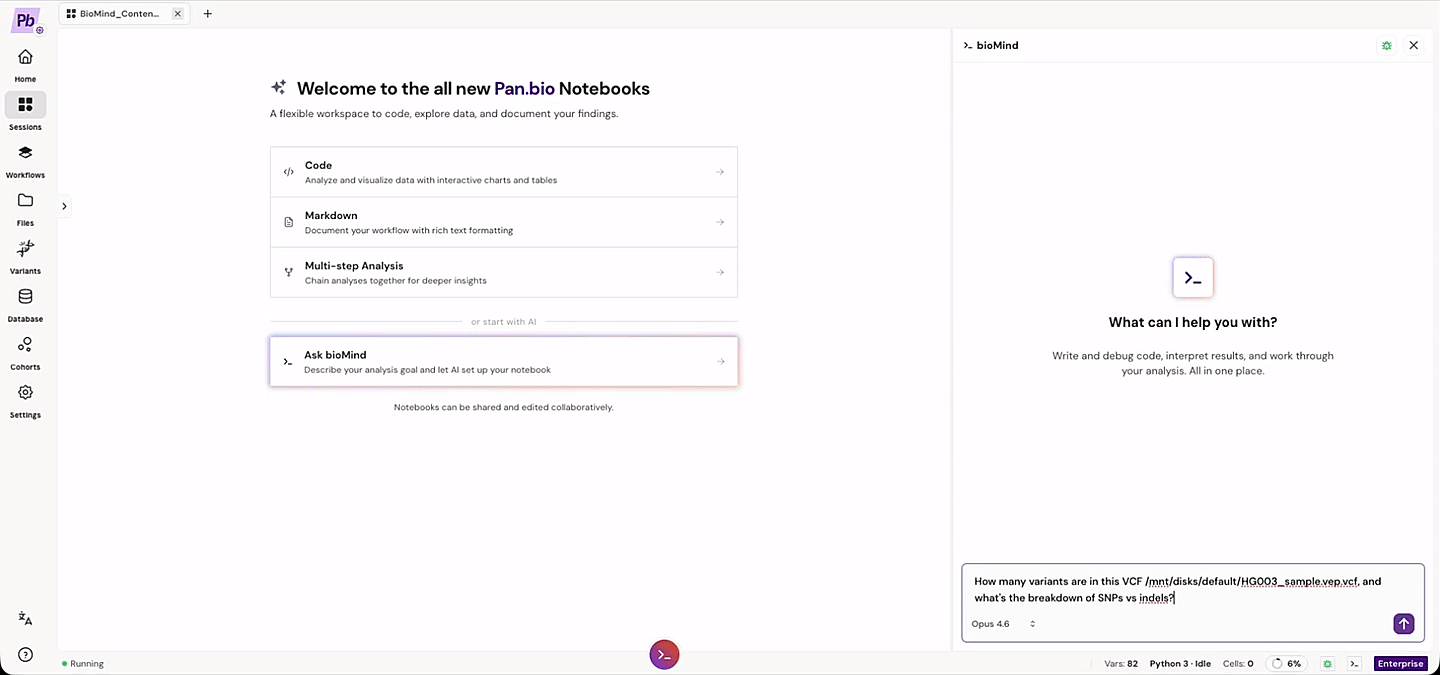
- Writes runnable code from plain English. Ask for a PCA, a filter, a differential-expression run; bioMind drops the Python or R into a cell for you to run.
- Works across data types. Expression matrices, variant files, alignments. It picks the right library on its own.
- Reasons about your data. Its choices track the data in front of it, with a short rationale, not just a code dump.
- Debugs real errors. A cell fails, bioMind reads the traceback, explains the cause, and proposes a fix. No copy-pasting into another tab.
- Shows its thinking, stays honest. You see how it got there before you run it, and it flags when a quick method is an approximation, not the rigorous one.
- Remembers and builds. Come back tomorrow and it picks up where you left off, with memory scoped to each user.
From quality checks and filtering to clustering, visualization, and statistical testing, bioMind handles the range these notebooks are built for. You set the goal, it handles the mechanics, you stay in control.
How do you use bioMind?
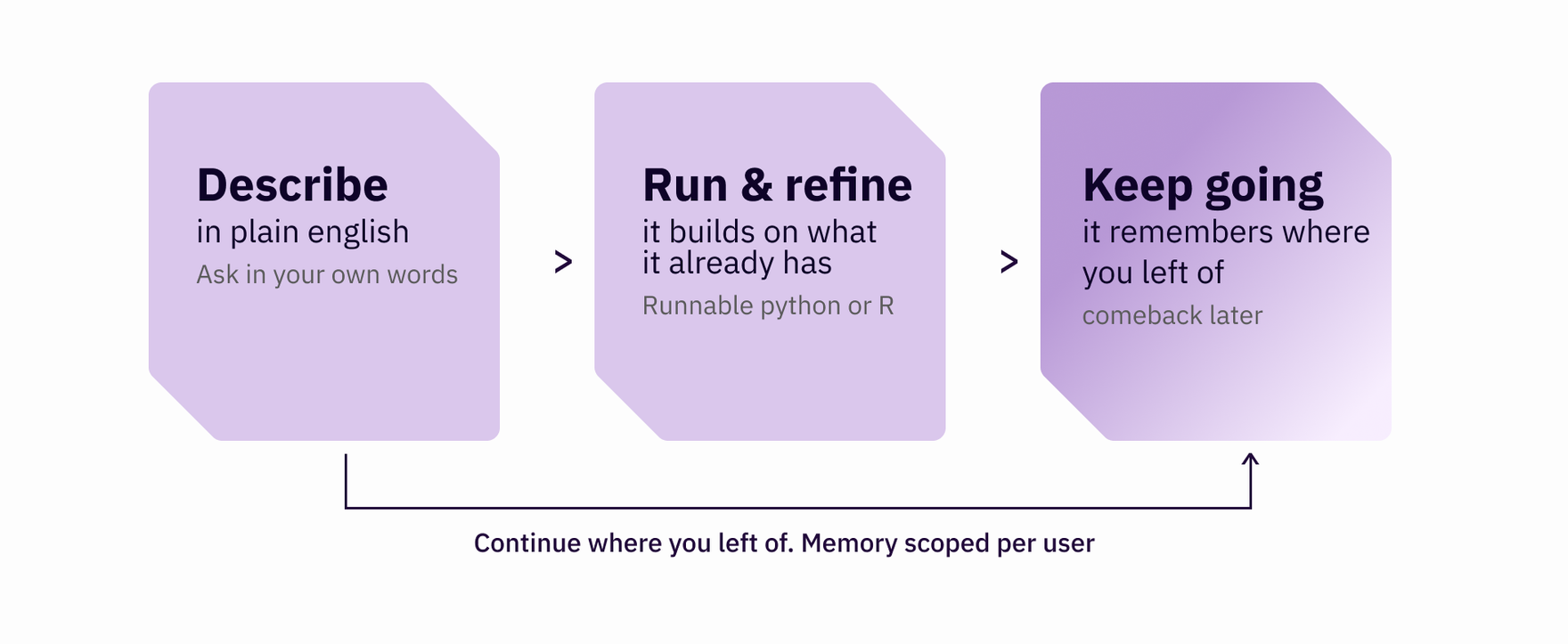
The loop is simple: describe what you want, review what bioMind writes, run it, keep going. Here is a typical first analysis, start to finish.
- Add your data, then describe what you want. Open a notebook and bring in your files. bioMind picks up your data, dataframes, columns, and cell outputs automatically, with nothing to paste in. Then ask, in plain language: "Run a PCA on my expression data and tell me whether the samples cluster the way the experiment predicts."
- Run and refine. bioMind writes runnable Python or R from your columns and drops it into a cell. You read it, then Run. The result appears below, and you keep shaping it in the same conversation, "color the points by tissue type," or "make that plot interactive so I can hover over each sample," and bioMind builds on what is already there instead of starting over.
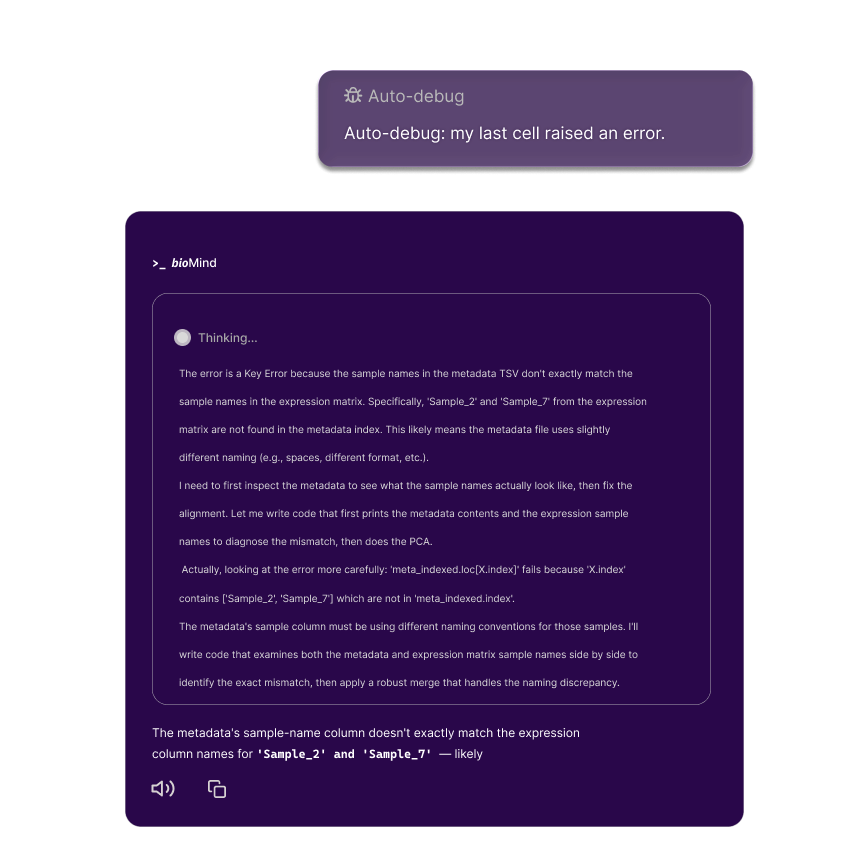
- Auto-debug when a cell breaks. If a cell raises an error, ask bioMind to fix it. It reads the traceback, works out the cause, and explains it in plain language, a sample-name mismatch between your data and your metadata, for instance, before writing the corrected code.
Keep going, and come back. Chain the next step, ask it to interpret a result, or pick the analysis back up another day. Close the notebook and reopen it later, and bioMind remembers where you left off, with memory scoped to each user.
You stay in control, and your data stays protected
For genomics teams, speed only matters if control stays intact. bioMind writes and suggests, but you review and run every step yourself, so nothing executes against the wrong dataset without you seeing it first. The model assists; the decisions stay with you.
The protections are structural, not an afterthought, because this is built for genomics and clinical data. Data is de-identified before it reaches bioMind, every organization's data is isolated from every other, processing is designed for your region, and write actions require your explicit confirmation.
Built to grow
bioMind is built on an open architecture, which is what lets it grow without being rebuilt. Through the Model Context Protocol, an open standard for connecting AI to external tools and data, new resources like pipelines or reference databases can plug in through configuration rather than code, and new skills are added the same way. The practical result: a capability built for one kind of analysis becomes available across your work, and bioMind keeps getting more capable over time, without you waiting on a new release.
Who is bioMind for?
Whether you write code every day or none at all, bioMind meets you where you are. If you do not code, you can finally run your own analyses without waiting on a bioinformatician. If you do, you skip the boilerplate and get back to the science.
bioMind is live in Notebooks today, and expanding across the rest of the Pan.bio platform. Subscribe to the Pan.bio newsletter to follow what ships next, and try bioMind in Notebooks right now.
FAQs
- What is bioMind? bioMind is the AI that powers every AI-assisted experience across the Pan.bio platform. It runs on Claude, and inside Pan.bio's Notebooks it helps you write code, debug analyses, and interpret results without leaving your workflow.
- Is bioMind a separate model trained on biology? No. bioMind is Claude, running inside the notebook environment, combined with notebook context, direct data access, and memory of your work. The intelligence is the frontier model; the domain fit comes from where it sits and what it can see.
- Can bioMind write both Python and R? Yes. bioMind generates runnable Python or R directly in the notebook.
- How is bioMind different from ChatGPT? Generic chat tools only see what you paste in. bioMind works inside the notebook, so it reads your files, columns, cell outputs, and error tracebacks in context, and writes code that fits your actual data.
- What kinds of data can bioMind work with? Expression matrices, variant files (VCF), alignments, and the other standard genomics and bioinformatics formats. It reaches for the right tools on its own, for example pysam for variant files and the scientific Python and R stack for expression data.
- Does bioMind run code automatically? No. bioMind writes and suggests code, but you review and run every step. You stay in control of what executes.
- BioAgents
How Are BioAgents Shaping the Future of Biomedical Applications and Clinical Decision Support?
introducing BioAgents, specialized agentic systems built on large language models (LLMs) that are designed to transform bioinformatics and clinical decision support.
- Announcement
Bionl is now Pan.bio: An end-to-end platform for the genomic era
Bionl is now Pan.bio. A new name for the end-to-end genomics platform built to move across functions, institutions, and populations.
- Literature Search
LLM’s Secret Sauce: Not Just Prompts, but Context Engineering
If you haven’t been living under a rock, chances are that you have come across the buzzword “prompt-engineering” in the past few years. And yes, while it has been recognized as an official job title in the tech industry, you probably have been practicing it on your own all along.