

VAIC is an intelligent orchestration platform designed to bridge the gap between raw genomic data and actionable clinical decisions, ingesting complex genetic data, cross-referencing global knowledge bases, and applying standardized ACMG/AMP scoring to transform thousands of variants into a prioritized, evidence-based list.
The Problem
Sequencing is fast and cheap. Interpretation is still the bottleneck.
Genomic sequencing has become routine, but turning raw variant data into a clinical decision remains fragmented, manual, and inconsistent.
Thousands of variants, one answer
A single patient's exome can surface thousands of genetic variants. Manually sorting through these to find the one causing disease is labor-intensive, error-prone, and inconsistent across labs.
Hours lost to cross-referencing
Teams spend hours cross-referencing scattered databases, applying complex classification guidelines, and documenting reasoning, often using spreadsheets that make reproducibility difficult.
Black-box tools, no audit trail
Existing tools either automate without transparency or leave everything manual. Neither approach gives clinicians the confidence or documentation they need for accreditation.
How It Works
From variants to classification
in four steps
A structured path from raw variant data to evidence-based clinical classification, automated, transparent, and auditable.
patient_001.vcf
4,218 variants
BRCA1:c.5266dupC
3 variants
TP53 · p.R175H
NM_000546
Step 01
Upload a VCF file, enter a list of variants in HGVS format, or input a single variant by gene symbol, variant notation, transcript, and reference genome.
-
Step 01: Submit Your Variants
Upload a VCF file, enter a list of variants in HGVS format, or input a single variant by gene symbol, variant notation, transcript, and reference genome.
-
Step 02: Select Your Guidelines
Choose from ACMG/AMP general guidelines, CanVIG-UK, ACGS rare diseases, ClinGen ENIGMA specifications, or gene-specific guidelines for BRCA1, BRCA2, TP53, ATM, APC, and MMR genes.
-
Step 03: Automated Evidence Aggregation
VAIC cross-references your variants against multiple evidence sources and automatically applies evidence criteria. Fully automatable criteria are scored instantly.
-
Step 04: Review & Finalize
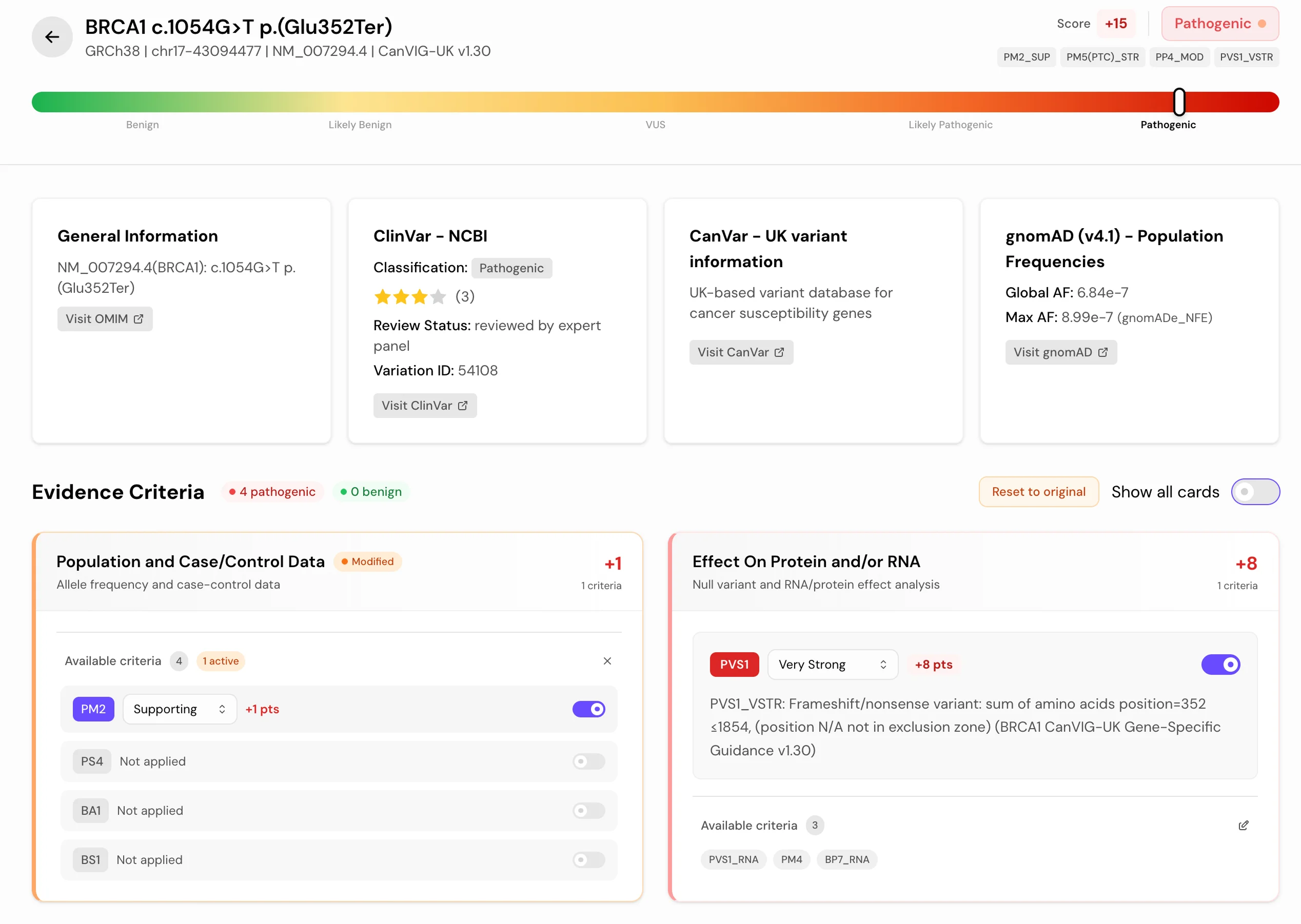
Each variant is presented with evidence cards, applied criteria with strength levels, and a pathogenicity classification. Toggle evidence, add notes, and the classification updates in real time.
Evidence Aggregation
Every source. One view.
No tab-switching.
VAIC aggregates evidence from established clinical and genomic databases in one centralized view, so clinicians can evaluate variants without leaving the platform.
Variant classifications and review status from global submitters.
Population frequency data across ancestry groups, allele frequency, allele count, and homozygosity.
Gene-disease associations and phenotype information.
Variant-specific literature search, retrieves papers, summarizes findings, and provides structured conclusions with citations.
BayesDel, REVEL, and SpliceAI for computational pathogenicity evidence.
Gene-specific functional studies and classification specifications for BRCA1/BRCA2.
Classification follows a point-based scoring system aligned to ACMG/AMP, CanVIG-UK, ACGS, ClinGen ENIGMA, and gene-specific guidelines.
Clinical Domains
Built for the core areas
of clinical genomics
Rare & Mendelian Diseases
Identifying the genetic cause behind undiagnosed pediatric and adult conditions where a single mutation often drives the phenotype.
Oncology
Analyzing tumor DNA to identify actionable mutations for targeted therapies, as well as assessing hereditary cancer risks.
Reproductive Health
Supporting carrier screening and prenatal genomic analysis to identify risks of heritable conditions.
Pharmacogenomics
Interpreting how a patient's genetic makeup affects their response to specific medications to optimize dosing and safety.
AI-Assisted Interpretation
Powered by BioMind.
Controlled by the clinician.
Two specialized agents work together inside VAIC, guiding evidence evaluation and surfacing relevant literature, while final classification always stays with the clinical user.
BioMind
AI Your AI co-pilot
for variant interpretation.
BioMind powers two specialized agents within VAIC: the VAIC Agent guides clinicians through non-automatable evidence criteria with applicable scores and rationale, while the Research Agent searches published literature and clinical databases, returning structured summaries with source citations.
Evidence Guidance
Guides clinicians through non-automatable evidence criteria with applicable scores and supporting rationale.
Literature Search
Searches published literature and clinical databases, returning structured summaries with source citations.
Report Q&A
Acts as a conversational interface over completed reports, ask questions about specific findings.
Conflict Detection
Surfaces conflicts between evidence sources and flags discrepancies for clinician review.
Human-in-the-Loop
The AI assists with evidence evaluation and literature search, but final classification decisions remain with the clinical user. Human-in-the-loop is a design principle, not a limitation.
What Makes VAIC Different
Transparent. Traceable.
Clinician-controlled.
Guideline-Aware, Not Black-Box
Every classification is grounded in established clinical standards. The reasoning is fully transparent, users see every evidence criterion applied, its strength level, and its point contribution.
AI-Assisted, Human-Controlled
The AI guides clinicians through non-automatable evidence, performs literature searches, and surfaces conflicts, but never overrides the clinician's judgment.
Unified with the Platform
VAIC integrates with Pan.bio's bioinformatics pipelines and Patient Cohorts, variant calls flow directly from Sarek into VAIC, creating an end-to-end workflow.
Full Audit Trail
Every classification decision, every evidence toggle, every user modification is logged for regulatory and accreditation purposes.
Enforced at the infrastructure level, your data stays in your jurisdiction, always.
See VAIC in Action
VAIC transforms variant interpretation from a manual, hours-long process into a structured, evidence-based workflow, grounded in established clinical guidelines, powered by AI assistance, and designed to keep the clinician in control.
No credit card required · Start in minutes