
Bioinformatics Role in Single-Cell Research
Single-cell biology is an emerging field that has shifted the paradigm from studying cells in bulk to understanding them at an individual level. This shift has led to groundbreaking discoveries in cell development, differentiation, and disease mechanisms.


Introduction
Single-cell biology is an emerging field that has shifted the paradigm from studying cells in bulk to understanding them at an individual level. This shift has led to groundbreaking discoveries in cell development, differentiation, and disease mechanisms. Bioinformatics for single-cell research has become an indispensable tool, especially when platforms like Bionl.ai are leveraged for data analysis.
The Role of Bioinformatics in Single-Cell Biology
Bioinformatics, the interdisciplinary field that employs computational methods to analyze biological data, is pivotal in single-cell biology. It helps researchers make sense of the complex and voluminous data generated by single-cell sequencing technologies. With Bionl.ai no-code platform, even researchers without computational expertise can delve into bioinformatics for single-cell research, and achieve a clearer understanding of their data.
Single-Cell Biology Research Stages
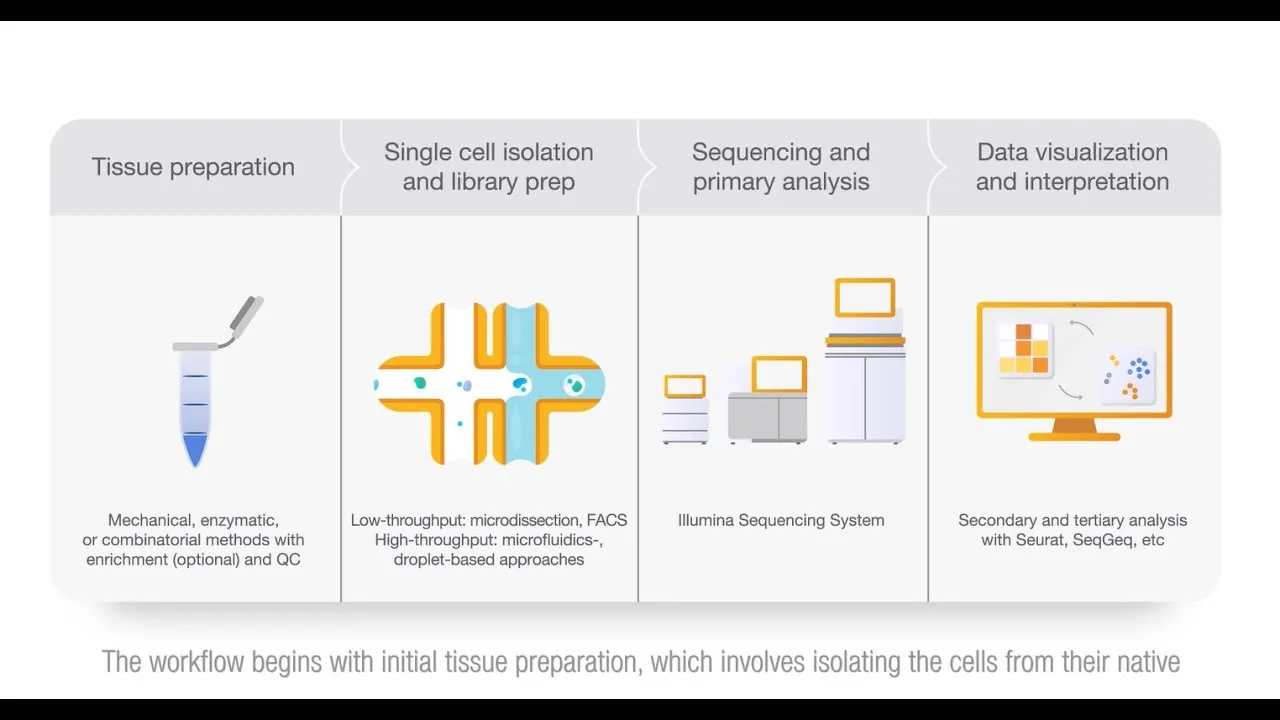
- Sample Preparation:
- Isolation: Cells are isolated from tissues or cell cultures using techniques like fluorescence-activated cell sorting (FACS) or magnetic-activated cell sorting (MACS).
- Quality Control: The isolated cells are assessed for viability and quality using microscopy or flow cytometry.
- Library Preparation:
- RNA Extraction: RNA is extracted from each isolated cell.
- Reverse Transcription: The RNA is converted into complementary DNA (cDNA) using reverse transcription.
- Amplification: The cDNA is then amplified to create a library of DNA fragments suitable for sequencing.
- Sequencing:
- Platform Selection: Choose between various high-throughput sequencing platforms like Illumina, PacBio, or Oxford Nanopore based on your research needs.
- Sequencing Run: The prepared libraries are sequenced, generating massive datasets.
- Data Analysis:
- Quality Check: Initial quality control of the sequencing data is performed.
- Alignment: The sequencing reads are aligned to a reference genome.
- Expression Quantification: Gene expression levels are quantified.
- Bioinformatics Tools: Platforms like Bionl.ai can simplify these steps, making it easier to derive actionable insights.
- Cell Clustering and Annotation:
- Dimensionality Reduction: Techniques like t-SNE or UMAP are used to reduce the complexity of the data.
- Clustering Algorithms: Cells are grouped based on their gene expression profiles using algorithms like k-means or hierarchical clustering.
- Annotation: Each cluster is annotated to identify the cell type or subpopulation it represents, often using known marker genes as references.
Illumina shows this video explanation for the single cell concept, highlighting its potential in biomedical research.
Innovations in Bioinformatics for Single-Cell Research
- Identify New Cell Types and Subpopulations: Advanced clustering algorithms can reveal previously unknown cell types.
- Study Cell Development and Differentiation: Bioinformatics tools can track the developmental trajectory of cells at the single-cell level.
- Discover New Biomarkers and Drug Targets: Machine learning models can sift through data to identify potential biomarkers for diseases like cancer.
- Integrate Multi-Omics Data: Platforms like Bionl.ai allow the integration of single-cell data with other data types, such as spatial transcriptomics and proteomics.
Real-World Applications
- Researchers at the Broad Institute leveraged bioinformatics to map out developmental trajectories in the human brain, identifying new cell types and subpopulations.
- A team at Stanford University used bioinformatics tools to discover new cancer biomarkers, paving the way for targeted therapies.
- At the University of California, San Francisco, scientists integrated scRNA-seq data with spatial transcriptomics, providing a comprehensive view of cell types in tissues.
The Future Landscape
As sequencing costs continue to plummet and new technologies emerge, bioinformatics for single-cell research is poised for exponential growth. Platforms like Bionl.ai are making it easier for researchers to engage in this complex analysis, heralding a new era of discoveries.
Bioinformatics is revolutionizing single-cell biology, offering unprecedented insights into cell types, development, and disease mechanisms. With the advent of no-code platforms like Bionl.ai, bioinformatics for single-cell research is becoming more accessible, promising a future filled with groundbreaking discoveries.
This Blog was co-authored using ChatGPT.

- BioAgents
Bion: Our Multi-Agent Biomedical System
This post introduces Bion, a multi-agent AI system designed to streamline biomedical research by automating data analysis, code generation, and visualization within a no-code notebook interface.
- nf-core
30–50% Faster in building AI Workflows? Exploring GPT-5 in Bioinformatics
30–50% Faster in building AI Workflows? Exploring GPT-5 in Bioinformatics GPT-5 introduces faster responses. In bioinformatics, GPT-5 streamlines workflows by drafting pipelines, configs, and annotations, reducing glue work and acting like a knowledgeable collaborator.
- Genomics
Your Genome Was Never in the Study, Only 1 in 600: Why Arab DNA Is the Biggest Blind Spot in Modern Medicine
Arab genetic architecture is its own genomic landscape, shaped by thousands of years of a unique demographic history, geographic isolation, and cultural practices that have no real parallel in the populations that dominate global genomic databases.