Why Build a National Genome Project? The Strategic Imperative, Infrastructure Decisions, Clinical and Economic Returns of Sequencing Your Own Population
Why build a national genome project? The answer is where data lives. Sequencing locally closes the reference gap that others watch widen

 Basel Abu-Jamous
 Thikra Daraghmeh
On this pageWe fail diagnostics when we reference a European genome. Sequencing your own population is the fix.
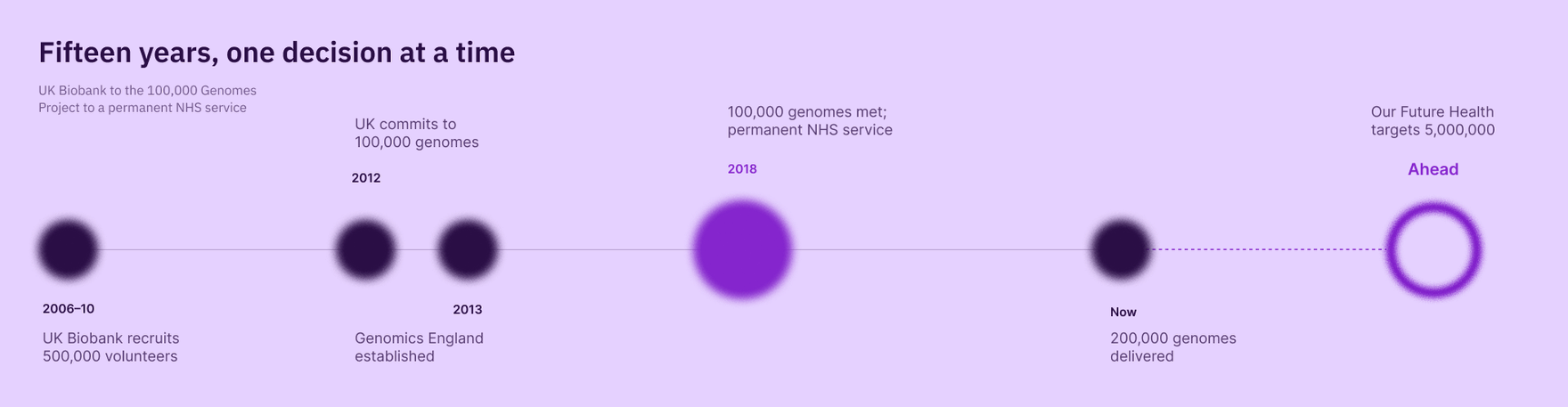
The NHS was the first national health service in the world to offer whole genome sequencing as part of routine care [1]. It got there through a deliberate sequence of decisions, made over fifteen years, that any country building a national genome project can study.
The foundation was laid early. UK Biobank recruited half a million volunteers between 2006 and 2010, building a research cohort with three decades of health record linkage attached [2]. That resource demonstrated what population-scale data could support, and in December 2012 the UK government committed to something more ambitious: sequencing 100,000 whole genomes from NHS patients with rare disease and cancer. Genomics England was established the following year to deliver it, and the target was met in December 2018, after five years [3].
The clinical results justified the investment. One in four participants with a rare disease received a diagnosis for the first time, and up to half of cancer patients received a clinically actionable result [4]. The percentages understate what that meant. Among those who finally received an answer, the average diagnostic odyssey had already lasted more than six years and involved 68 hospital visits [5].
But the diagnoses were not the return. What the project actually built was the largest whole genome dataset linked to lifelong health records anywhere in the world, and the operational machinery to run it: thirteen genomic medicine centres, a consent framework, a national interpretation pipeline, and a working route from sample to clinician [1]. In October 2018, that machinery was commissioned as a permanent service, extending genomic testing to England's entire population of 55 million [1]. It has since sequenced a further 100,000 whole genomes, doubling the number delivered for NHS patients since the original project closed recruitment [6]. Our Future Health, now recruiting, is aiming for 5 million [7].
The project ended. The capability did not.
That is the distinction worth holding onto. A national genome project is not a research programme that concludes with a dataset. It is infrastructure a country builds once and then operates, and almost everything determining what it eventually returns is decided at the start.
We fail diagnostics when we reference a European genome. Sequencing your own population is the fix.
Clinical genomics runs on reference databases, and those databases carry the genetic signature of whoever was sequenced first. gnomAD, the field's principal reference, states the mechanism in its own documentation: genetic ancestry groups will not form distinct clusters unless there is adequate representation of that group within the dataset. In version 4, over 31,000 samples could not be assigned to any ancestry group at all [8].
This is not a peripheral criticism. UK Biobank, the most heavily used genomic resource in the world, names the same limitation in its own release materials: a predominance of participants of European heritage, with relatively few people of African and Asian descent [9]. When a resource of that quality acknowledges its own reference bias, the implication for every health system building on it is direct.
What that costs is measurable. Phase 1 of the Qatar Genome Program sequenced 6,045 individuals and identified more than 88 million variants, of which 24.6 million were novel, meaning that for each individual, roughly 1.86% of their detected variants had no prior record in any existing reference database [10]. Hong Kong found the same problem from the other direction: screening its population against supposedly pan-ethnic clinical gene lists built on European data, 38 clinically important genes would have been overlooked entirely [11]. The reverse also holds, and it is the operative point. A national cohort makes each subsequent interpretation more accurate than the last.
Localising the process, not just the data
The decision that determines whether a country closes that gap or watches it widen is not where genomic data is stored. It is where the process happens: generation, processing, interpretation, and storage together. Localisation of the whole pipeline is what compounds. Exporting any part of it is what leaks.
Where testing is performed abroad, the reference data accumulates elsewhere, and interpretation continues to rely on populations that do not represent the patients being tested. The accuracy gap persists no matter how many samples are sent, and in a mature national programme the in-country answer eventually becomes the more accurate one, not merely the equivalent one. Where the process is performed locally, each analysis adds to a national reference resource, and interpretation improves as the cohort grows.
The asymmetry is what makes this a decision rather than a preference. Localising at the outset costs relatively little. Reversing course after volume has accumulated somewhere else costs a great deal, and some of what was lost cannot be recovered at all.
What the data is worth once it exists

A national genome database is not only a diagnostic reference. It is research material, and this is where the returns that justify the investment actually originate.
The scale of that use is well documented. UK Biobank has supported over 18,000 peer-reviewed publications and serves more than 30,000 registered researchers across more than 90 countries [12]. FinnGen's results are integrated into the Open Targets platform for drug target prioritisation, giving pharmaceutical partners a route from population genetics to candidate therapies [13]. Genomics England describes its own legacy in these terms: a genomics service adopted by the NHS, new medicines and diagnostics, and a country that hosts some of the world's leading genomic companies [3].
None of that happens if the data sits unexamined. Which raises the question every programme has to answer before it opens the door: how do you let researchers work with a national population's genomes without losing control of them?
Access is far easier to design than to retrofit
A clear standard has emerged in the field. The older model sent copies of data out to approved partners, which meant control ended at the point of transfer. The current standard inverts it: the data does not move. Approved researchers work inside a secure national environment, and only reviewed aggregate results leave. Individual-level records cannot be exported at all.
This is now formal expectation rather than best practice. In 2026 the UK government issued guidance to major holders of human genomic data covering Secure Data Environments, the Five Safes framework, and transfer risk assessments that treat genomic data as a high harm risk category [14]. The Health Research Authority noted the guidance was timely following concerns relating to UK Biobank data [15]. When the most open genomics ecosystem in the world formalises limits on where its genomic data may travel, the direction of the field is not ambiguous. It is worth being precise about what these models are: FinnGen, for instance, is a controlled access resource, and individual-level data is available only to consortium partners [13].
Consent is the sharpest illustration of why this has to be settled early. Consent drafted narrowly at the point of collection permanently caps what the data may later be used for, and no subsequent investment reverses it. A programme that did not anticipate industry partnerships, international collaboration, or reanalysis years later will find those doors closed by its own paperwork. Governance designed before the first sample is collected costs a fraction of governance imposed after the data already exists.
The anatomy: what to settle before collection begins
Most of what determines whether a programme works is architectural, and nearly all of it has to be settled before any data is collected. The design principle underneath it is separation: identity is never joined to research use.
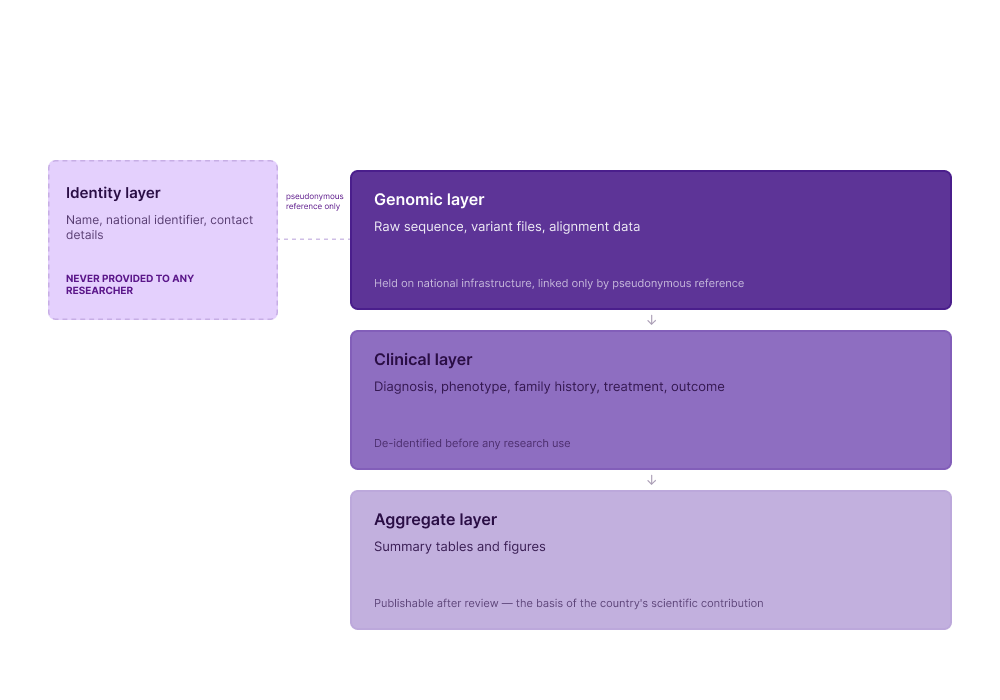
- Identity layer. Name, national identifier, contact details. Held in a separate system, never provided to any researcher.
- Genomic layer. Raw sequence, variant files, alignment data. Held on national infrastructure, linked only by a pseudonymous reference.
- Clinical layer. Diagnosis, phenotype, family history, treatment, outcome. De-identified before any research use.
- Aggregate layer. Summary tables and figures. Publishable after review, and the basis of the country's scientific contribution.
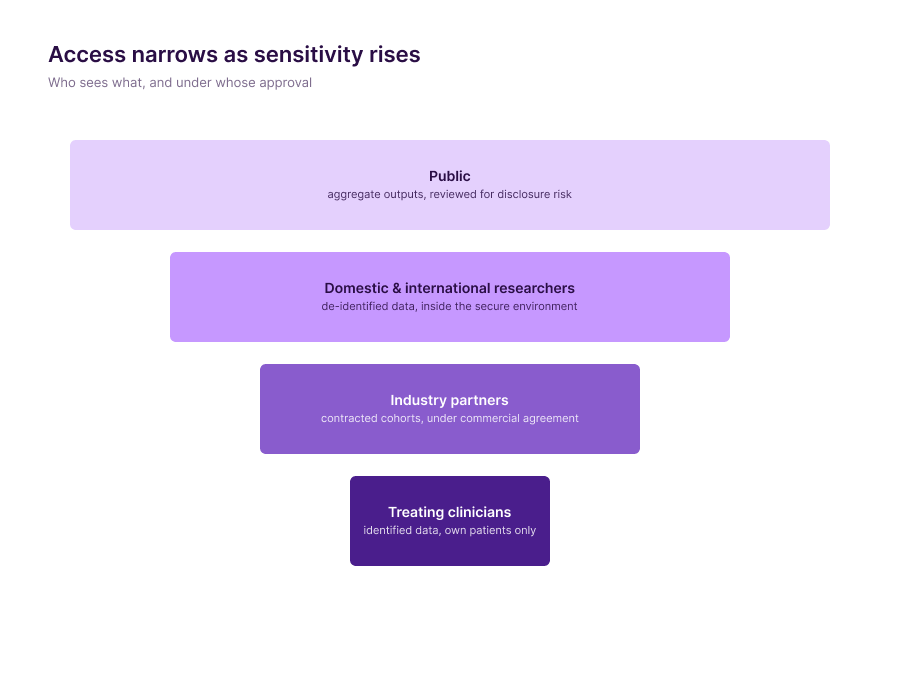
Access is granted in tiers, each with a named approving authority. Treating clinicians see identified data for their own patients only. Domestic researchers and international academics work with de-identified data inside the environment. Industry partners access contracted cohorts under commercial agreement. Every query is logged and attributable, and every output is checked for identifiers and disclosure risk before release. Three bodies hold decision rights: a national committee owns strategy and escalation, an ethics committee owns the consent model and return of results, and a data access committee approves or refuses every application and every export.
Two operational pillars sit alongside the architecture. Funding anchored in recurrent health system budgets rather than research grant cycles, since programmes face their hardest transition exactly when they move from research to clinical service [16]. And computational capacity that keeps pace with sequencing capacity, since sequencing is now fast and inexpensive while the infrastructure to align, annotate, interpret, and store at population scale is neither [17]. Underneath all of it sits the clinical value chain. Genomic data is only as valuable as the clinical context attached to it, and programmes that never link sequence to longitudinal health records produce static data points rather than clinical tools.
Access design is what makes the economics work
The common assumption is that governance constrains commercial value. The evidence points the other way, and the mechanism is specific.
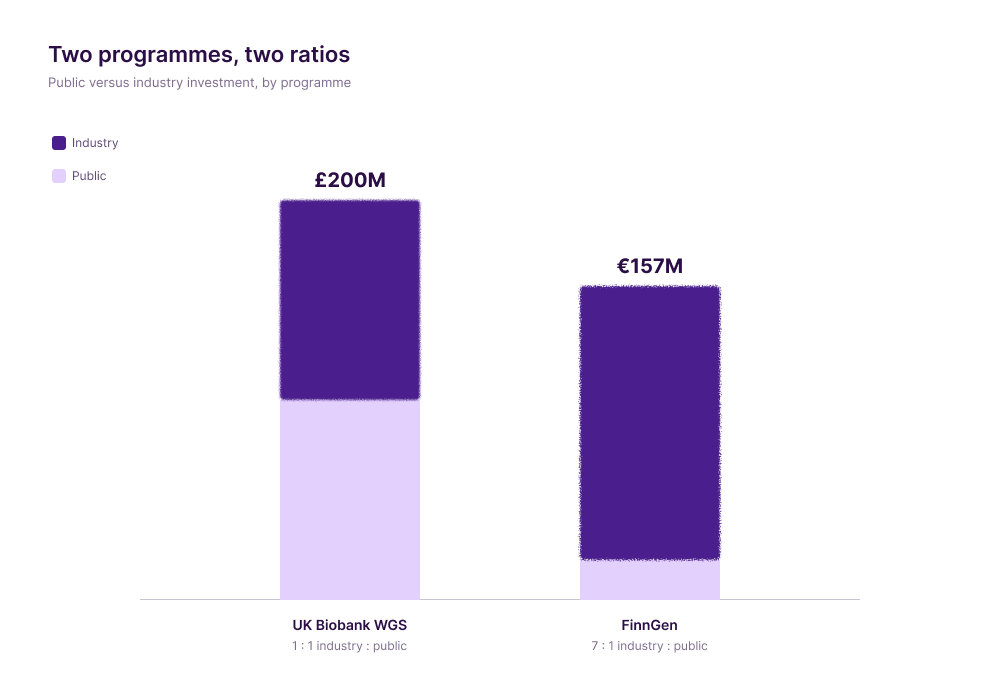
FinnGen is the clearest case. Business Finland committed approximately EUR 20 million; the total programme budget now exceeds EUR 157 million, with the remainder coming from fifteen international pharmaceutical partners [11]. That is roughly seven euros of industry investment for every euro of public funding. UK Biobank's whole genome programme used a comparable structure: approximately GBP 200 million in total, of which the four industry partners contributed GBP 25 million each and UKRI and the Wellcome Trust covered the other half [18]. In return, industry members received nine months of exclusive access, after which the data became available to approved researchers worldwide [19].
The detail that matters is what was not sold. UK Biobank charges researchers only to cover the cost of handling access applications, with reduced fees for students and researchers in lower income countries [20]. What the consortium bought was time, not ownership. A country that has already exported its genomic data has no time to sell, and no asset to license. Sovereignty is not a constraint on the business model. It is the business model. The downstream effect is sectoral: as of the 2022 Genomics Nation report, the UK genomics sector comprised 154 companies employing over 5,000 people and attracting 34% of national life sciences investment [21].
What building one looks like in practice
The sequencing that matters is programmatic, not technical. Governance is approved before collection begins, and controls are verified before data enters the system. Reversing that order is what creates the retrofit problem.
- Phase 0, Discovery. Readiness assessment across data, laboratory, regulatory and clinical maturity. Concludes with confirmed scope.
- Phase 1, Foundation. Governance framework, ethics policy, consent model, data standards, security architecture. Approved before collection.
- Phase 2, Build. Platform deployed in-country, controls implemented and verified before data enters.
- Phase 3, Scale. Cohorts curated, partnerships opened under controlled access, each approved individually.
One example of this architecture in operation: Pan.bio operates a national genomics platform in the Gulf, structured across four verticals: the hosting platform itself, bioinformatics pipelines, clinical and research variant interpretation, and cohort commercialization. The permissions posture is deliberate. The platform operator holds no access to the identity layer and no commercial right over aggregate outputs. Those remain with the country.
The data will be generated either way. The only question is who owns it.
Genetic testing volume is rising in every health system, driven by falling costs and widening clinical indications. That is not a policy choice. What is a policy choice is whether a country builds the infrastructure to perform that testing itself, and what it has accumulated at the end of a decade of doing so.
Without a national programme, the testing still happens. The results still come back. But the reference data enriches someone else's database, the interpretation stays calibrated to someone else's population, and there is no asset at the end of it. With one, a country gets the diagnoses, plus a reference database that grows more accurate every year, plus a governed asset that industry will pay to access on terms the country sets, plus a genomics industry that attracts investment, builds capacity, and creates careers.
The programmes that lead the next decade will not be the ones that sequenced the most genomes. They will be the ones whose data still belonged to them when the value arrived.
References:
[1] OECD Observatory of Public Sector Innovation. 100,000 Genomes Project. https://oecd-opsi.org/innovations/100000-genomes-project/
[2] UK Biobank. Our history. https://www.ukbiobank.ac.uk/about-us/our-history/
[3] Genomics England. 100,000 Genomes Project. https://www.genomicsengland.co.uk/initiatives/100000-genomes-project
[4] NHS Genomics Education Programme. 100,000 Genomes Project, Knowledge Hub. https://www.genomicseducation.hee.nhs.uk/genotes/knowledge-hub/100000-genomes-project/
[5] NHS Genomics Education Programme. 100,000 Genomes Project 2021 update: rare disease. https://www.genomicseducation.hee.nhs.uk/blog/100000-genomes-project-2021-update-rare-disease/
[6] Genomics England. 100,000 whole genomes sequenced through the NHS GMS. https://www.genomicsengland.co.uk/news/100-000-whole-genomes-sequenced-through-the-nhs-gms
[7] UK Biobank. Should you participate in Our Future Health? https://www.ukbiobank.ac.uk/taking-part/our-agreement-with-you/should-you-participate-in-our-future-health/
[8] gnomAD. Genetic Ancestry in gnomAD v4. Broad Institute. https://gnomad.broadinstitute.org/news/2023-11-genetic-ancestry/
[9] UK Biobank releases largest ever genome sequencing dataset. Pharmaphorum, 2023. https://pharmaphorum.com/news/uk-biobank-releases-largest-ever-genome-sequencing-dataset
[10] Mbarek H, Ismail SI, et al. Qatar genome: Insights on genomics from the Middle East. Human Mutation. 2022;43(4):499-510. https://onlinelibrary.wiley.com/doi/10.1002/humu.24336
[11] Ying D, et al. Population-scale genomic medicine with the Hong Kong Genome Project. Nature Medicine. 2026. https://www.nature.com/articles/s41591-026-04410-w
[12] UK Biobank. Discoveries and Impact. https://www.ukbiobank.ac.uk/discoveries-and-impact/
[13] FinnGen. Funding. https://www.finngen.fi/en/funding
[14] Safeguarding UK human genomic data. UK Government guidance, 2026. https://www.gov.uk/government/publications/safeguarding-uk-human-genomic-data/safeguarding-uk-human-genomic-data
[15] Health Research Authority. Our response to new guidance on safeguarding UK human genomic data. 2026. https://www.hra.nhs.uk/about-us/news-updates/our-response-to-new-guidance-on-safeguarding-uk-human-genomic-data/
[16] Howley C, Haas MA, Al Muftah WA, et al. The expanding global genomics landscape: Converging priorities from national genomics programs. American Journal of Human Genetics. 2025;112(4):751-763. https://www.cell.com/ajhg/fulltext/S0002-9297(25)00055-2
[17] Lee H, et al. Lessons from national biobank projects utilizing whole-genome sequencing for population-scale genomics. Genomics & Informatics. 2025. https://link.springer.com/article/10.1186/s44342-025-00040-9
[18] UK Biobank releases whole genome sequencing data for all 500K participants. GenomeWeb, 2025. https://www.genomeweb.com/sequencing/uk-biobank-releases-whole-genome-sequencing-data-all-500k-participants
[19] UK Biobank. World's largest genetic project opens the door to a new era for treatments and cures. https://www.ukbiobank.ac.uk/news/worlds-largest-genetic-project-opens-the-door-to-new-era-for-treatments-and-cures-uk-biobanks-major-milestone/
[20] UK Biobank. Fees. https://www.ukbiobank.ac.uk/use-our-data/fees/
[21] BIA, Wellcome Sanger Institute, Medicines Discovery Catapult. Genomics Nation report, 2022. https://www.bioindustry.org/resource/genomics-drives-uk-life-science-success-new-report-finds.html

Founder and CEO at Pan.bio. MD.
View full profile

Your Genome Was Never in the Study, Only 1 in 600: Why Arab DNA Is the Biggest Blind Spot in Modern Medicine
Arab genetic architecture is its own genomic landscape, shaped by thousands of years of a unique demographic history, geographic isolation, and cultural practices that have no real parallel in the populations that dominate global genomic databases.
Ahmad Jadallah6 minBionl is now Pan.bio: An end-to-end platform for the genomic era
Bionl is now Pan.bio. A new name for the end-to-end genomics platform built to move across functions, institutions, and populations.
236 Sarcomas Profiled in One Sitting. Two Routes to One Broken Pathway
We ran a full multi-omic sarcoma analysis in a single session of Pan.bio Notebooks. Every step was a plain-English question to bioMind. The most interesting result was one we never asked for.