How to Choose Clinical Bioinformatics Software: 8 Questions to Ask Before You Buy
How to evaluate clinical bioinformatics software before you buy: 8 questions covering validation, AI governance, data residency, population coverage, cost, and vendor lock-in.

 Thikra Daraghmeh
On this pageStart with the tests, not the software
As artificial intelligence rapidly emerges across the biotechnology landscape and software solutions drive breakthroughs in genomics, laboratories adopting these platforms are confronting critical operational realities. Behind the promise of speed lie fundamental questions that determine real-world viability: Can these platforms be validated for clinical diagnostic reporting? How significant is the gap created by unrepresentative reference panels for diverse patient populations? And as AI takes on a larger role in processing and analysis, how much can laboratories truly trust the results?
While most tools compete on feature checklists and faster turnaround times, efficiency that is undoubtedly essential, they also compete on implicit assumptions about who you are, how your team operates, and what you will do with the findings. Yet far fewer address critical foundations such as data security, compliance, and population relevance. Whether you are a bioinformatician, geneticist, laboratory director, or biotech executive, here are the essential questions you should be asking when evaluating bioinformatics platforms.
Start with the tests, not the software
Every answer below shifts depending on what you intend to report. Software that handles germline panels cleanly can struggle badly with low-allele-frequency somatic variants in FFPE material, and plenty of platforms do not call repeat expansions at all.
So before the first demo, write the list: germline panels, exome, genome, somatic oncology, pharmacogenomics, RNA, copy number and structural variants, mitochondrial variants, repeat expansions. Then evaluate against your list rather than the dataset the vendor picked, which was almost certainly chosen because it performs well on it.
This is not a matter of preference. Both the FDA's guidance on analytical validation of NGS-based diagnostics and the CCMG laboratory guidelines frame validation around intended clinical use, covering the specimen types, variant classes and workflows a laboratory will actually report [1,2].
A flawless demo on clean public data tells you very little about your FFPE blocks.
1. What is already validated, and what is left for us to validate?
Picture two vendors. Both quote above 99% performance on their validation dataset. Vendor A hands you the aggregate number. Vendor B hands you performance broken out by SNV, indel, CNV and structural variant, by specimen type, by coverage threshold, and names the reference materials used.
Only one of those is an answer.
So the questions worth asking are which components carry documented validation and what evidence arrives with them, what remains your responsibility, and whether you can run your own reference and positive control material through the production pipeline before go-live. Performance across variant classes is rarely uniform, and an aggregate figure hides exactly the class you are about to have trouble with.
Red flag: "the pipeline is validated," with nothing after it. Validated for which assay, at what coverage depth, on which specimen types, against which reference materials? Clinical guidance treats the pipeline end to end as the object of validation rather than individual components assessed in isolation [2,3].
Try this during the evaluation. Send us your data and the results you already have, whether they came from your own pipelines or another vendor’s, and we will run the benchmark ourselves and show you how ours compares on your samples. You get the comparison before you commit to anything, and it is a better basis for a decision than any performance figure we could quote you, including our own.
2. What happens when the vendor updates the pipeline?
You validate version 3.2, with reference build X and annotation database Y. Six months later, version 3.3 arrives.
Find out whether updates are opt-in or automatic, and whether you can pin a version for a validated assay while evaluating the next one in parallel. Ask whether reference builds and annotation databases are versioned alongside the pipeline or separately, since either can change a result on its own. Ask what the release notes contain, and which categories of change trigger revalidation.
What this means operationally: an annotation database refresh can change a variant's classification without a single line of pipeline code changing. If your lab learns that from a patient report rather than a release note, the failure is in quality management, not software. Published recommendations on bioinformatics in clinical practice are explicit about version control across tools, databases and parameters for this reason [3,4].
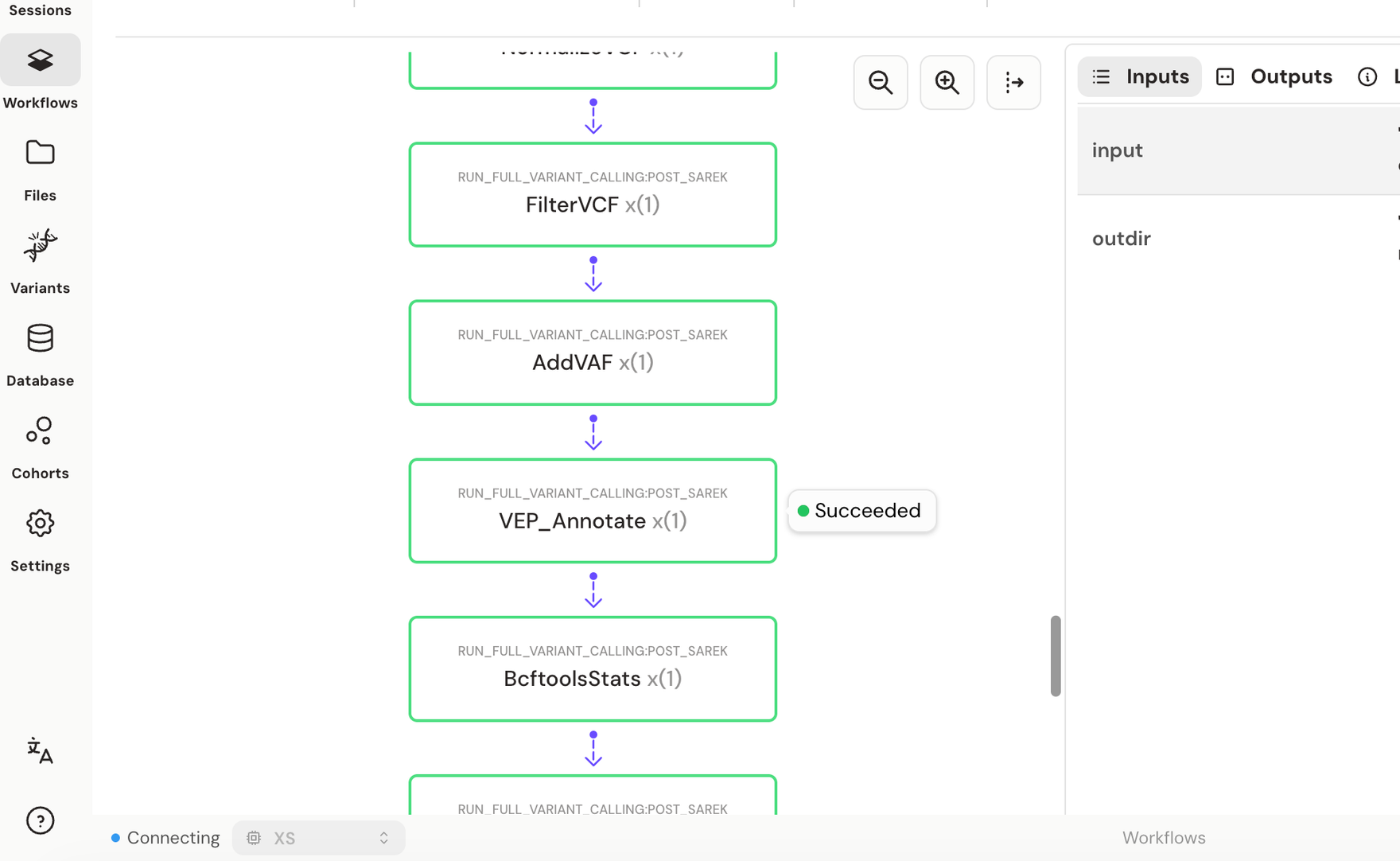
How Pan.bio answers this. Updates are never forced. Each pipeline’s version is selected from a dropdown, so a team moves when it is ready, and an organization can lock a validated version so its teams keep running exactly that one. There is no expiry on a locked version. Locking works at the workflow level or across the organization, and individual workspaces can run different versions where that is useful. Reference and annotation versions travel with the pipeline version, either in the pipeline configuration or in the storage location the data is read from, and the exact versions in use are listed in the pipeline’s About section and in the parameters file produced by every run.
3. Cloud, on-premise, or hybrid, and where does patient data physically live?
This is the most argued-over question in practitioner forums, and the answer genuinely depends on your data volume, your regulatory environment, and whether you employ people who can run infrastructure.
Your own infrastructure | Vendor-hosted cloud | |
|---|---|---|
Data residency | Entirely under your control | Limited to available regions |
A peak week | Capped by hardware already bought | Elastic |
Idle cost | Paid for either way | Pay for what runs |
Patching and monitoring | Your team | The vendor |
Most underestimated line | Staff time, refresh cycles, downtime | Storage, egress, long-term retention |
Which hosting regions are live today, as opposed to planned? Is tenant isolation logical or physical? What is encrypted at rest and in transit, and who holds the keys? Which certifications, with what scope and what audit date, not just which logos?
Don't accept a yes or no here. "We're compliant" is not a scope statement, and a certification without an audit date is a historical artifact.
How Pan.bio answers this. The data lives where you decide. Pan.bio is cloud agnostic and deploys on-premise, in your own cloud tenancy, or hybrid, which matters most for institutions operating under data residency rules that rule out a single-region SaaS by default.
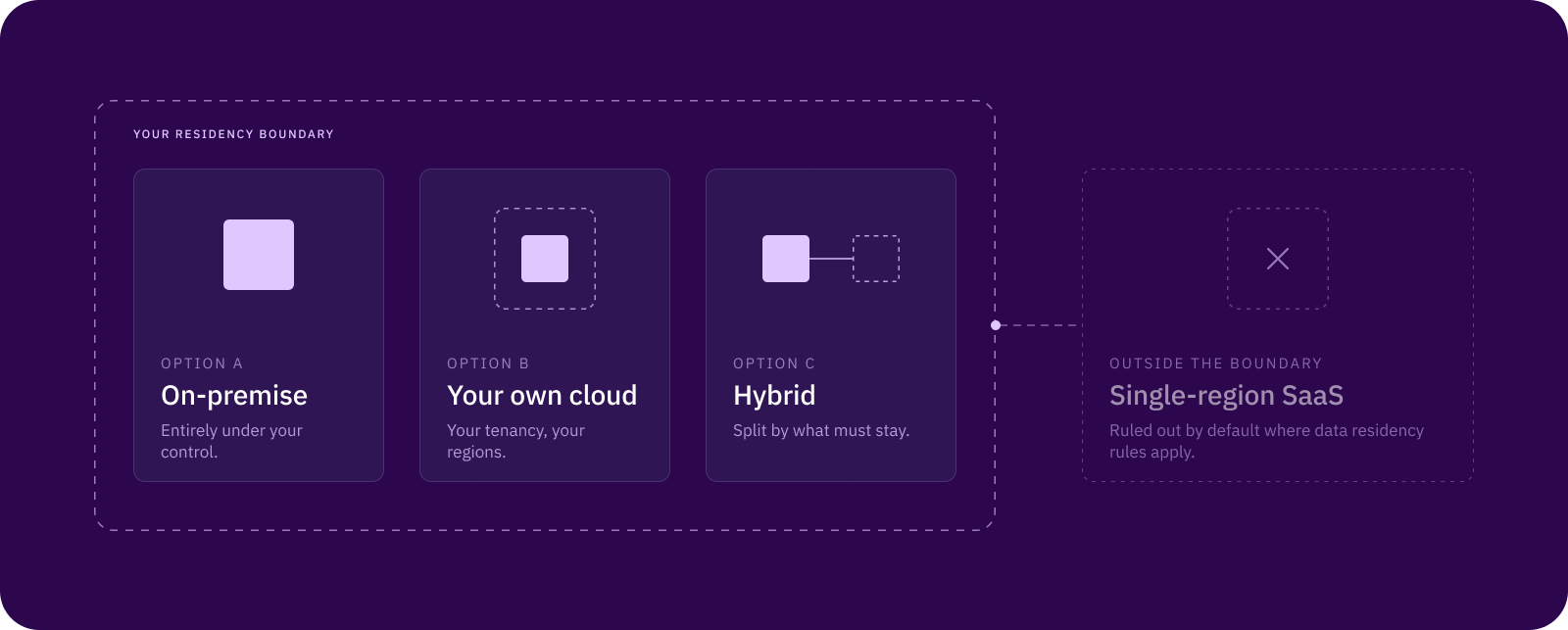
If you operate under those rules, ask this question first of every vendor. It is the shortest route to a shortlist.
4. What will this cost to run, not to license?
The subscription line is the smallest part of the number. Two lines get underestimated more than any others, storage over the full retention period and the staff time absorbed by whatever the platform does not automate. Price both explicitly, because no proposal will show you either.
Cost line | The question |
|---|---|
License or subscription | Per seat, per sample, per user, or flat? |
Compute | Included, metered, or billed to our own cloud account? |
Data transfer | Are there egress charges when we pull data out? |
Implementation | Who builds and configures the workflows, at what rate? |
Validation support | How much of the validation work stays with us? |
Reanalysis | Is re-running a case three years from now charged again? |
Training and support | Included, or a separate tier, with what response commitment? |
A scientist spending two days a month reformatting output costs roughly a quarter of an FTE a year. Put that in the model and the cheapest quote often stops being the cheapest option.
5. How much coding does it really require?
"No-code" and "low-code" get used loosely, and the distinction that matters is what happens at the edges.
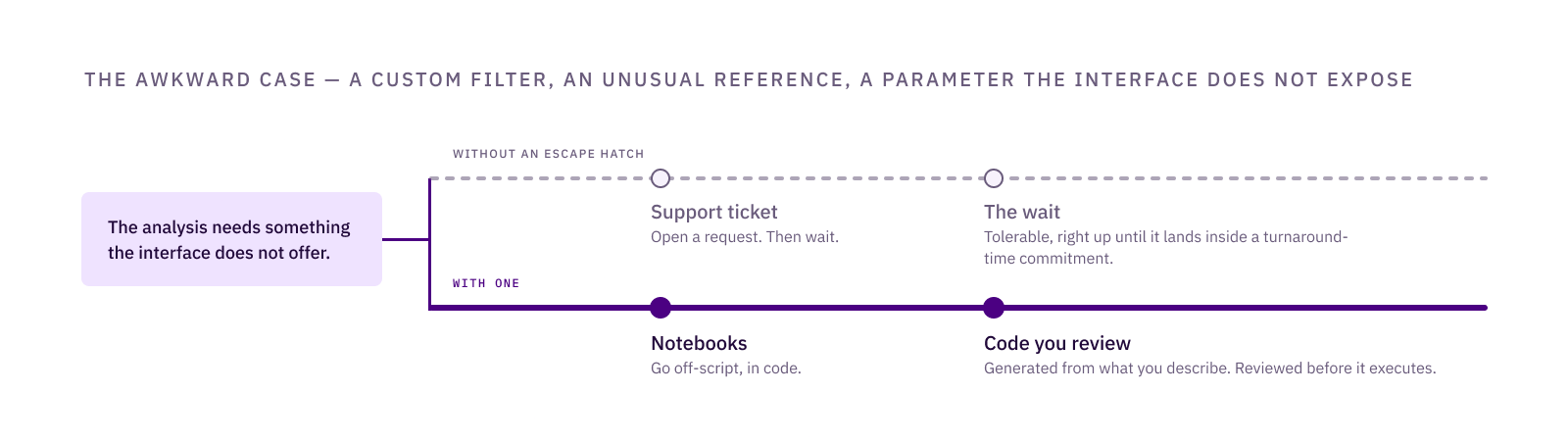
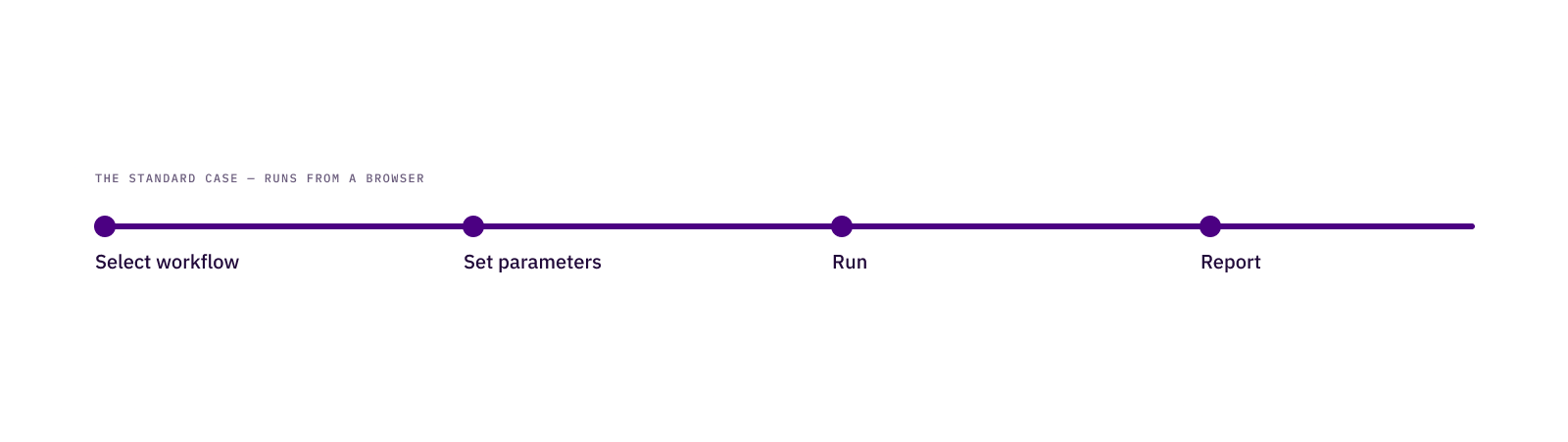
Standard pipelines with standard parameters run from a browser on most modern platforms. The awkward case is the real test: a custom filter, an unusual reference, a parameter the interface does not expose. Some platforms let a bioinformatician drop into code at that point. Others require a support ticket and a wait, which is tolerable right up until the wait lands inside a turnaround-time commitment.
Request two demonstrations, in this order. A complete analysis run by someone who has never opened the tool. Then, what happens when the analysis needs something the interface does not offer.
How Pan.bio answers this. Pan.bio is a no-code platform. Workflows run in clicks, and Notebooks are there for the analyses that need to go off-script, where bioMind turns what you describe into runnable code that you review before it executes. The escape hatch is the part worth checking in any demo, ours included.
6. Does the interpretation layer fit our patient population?
This question is easy to overlook, but it can have consequences that are difficult to see in a software demo.Variant classification leans heavily on population allele frequencies. When a patient's ancestry is thinly represented in the databases underneath the platform, variation that is common and benign in that population looks rare. Rare looks suspicious.
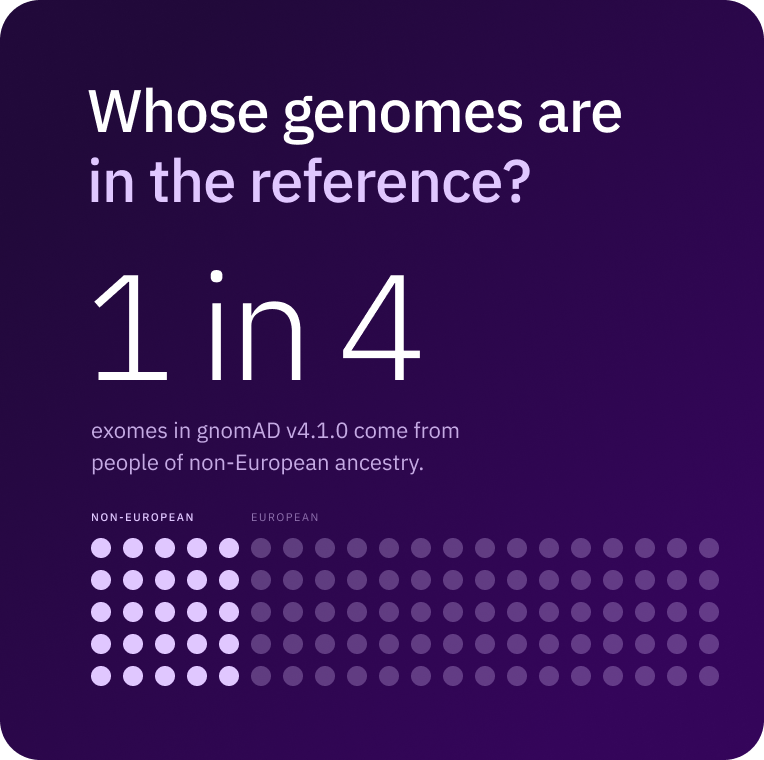
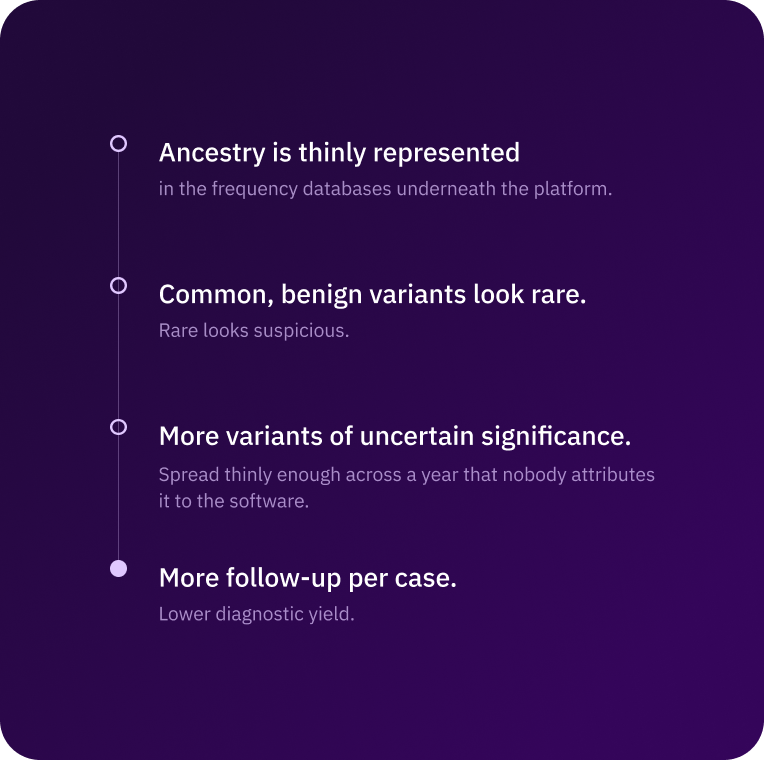
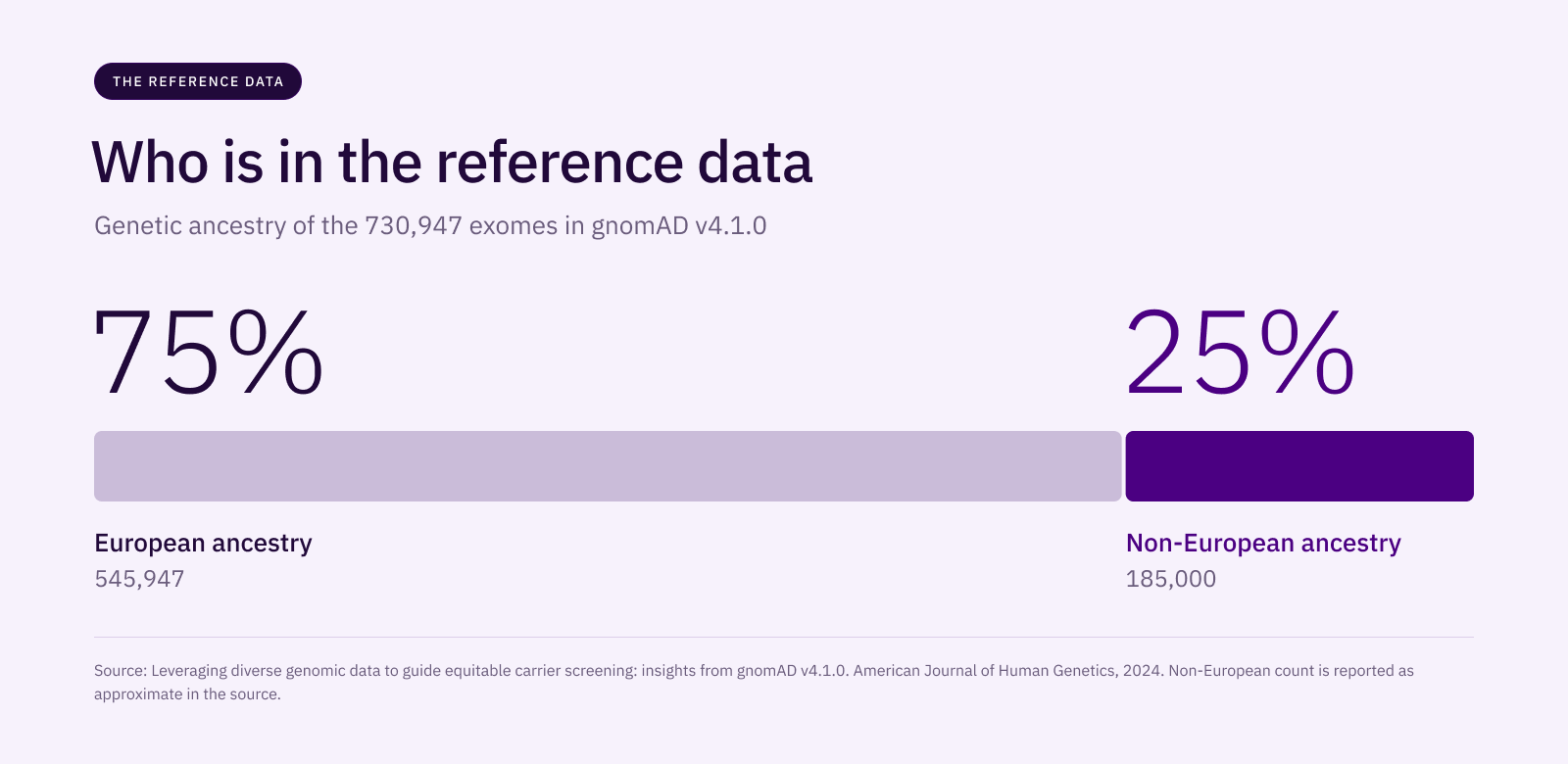
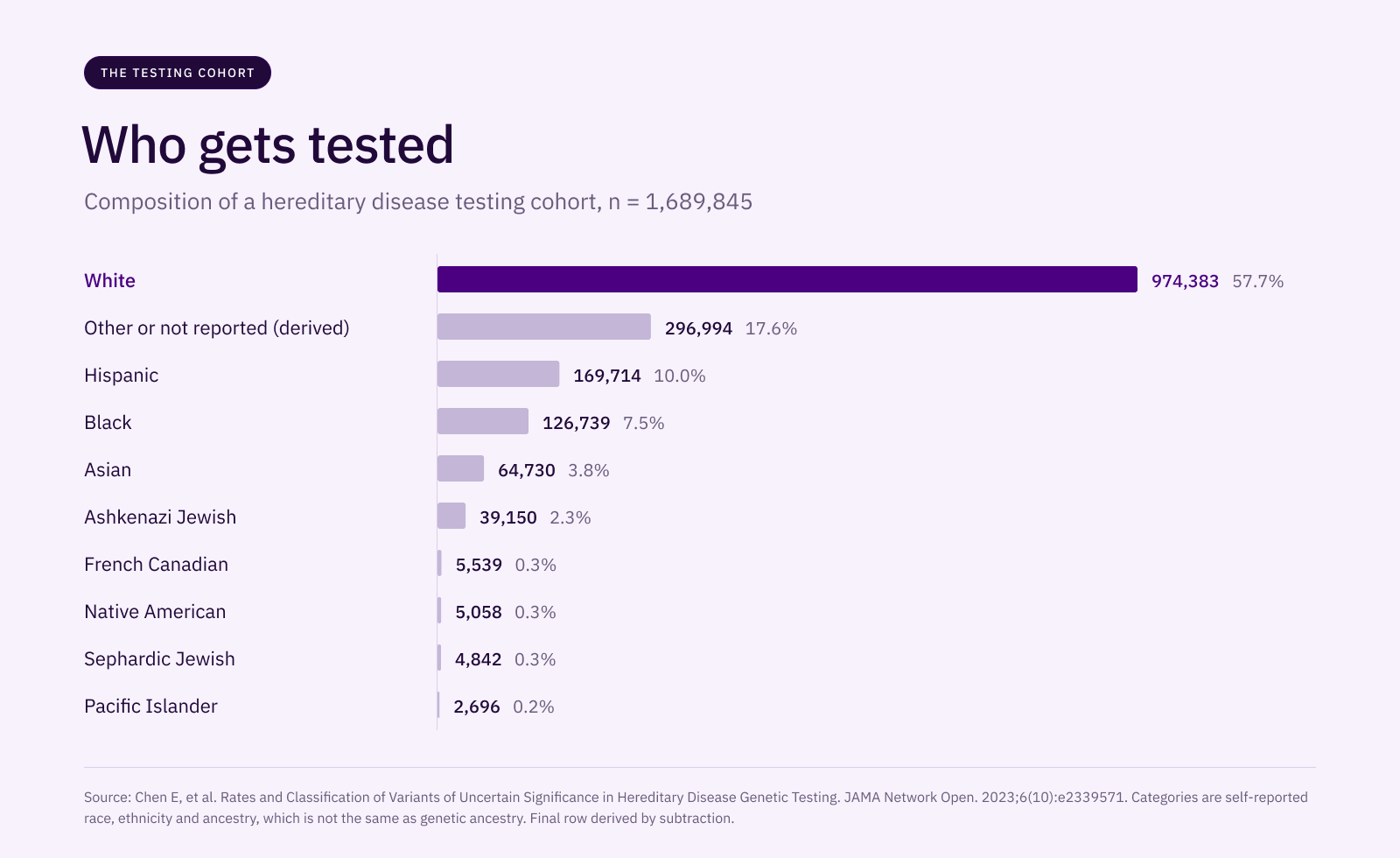
One quarter of the exomes in gnomAD v4.1.0 come from people of non-European ancestry [5]. That single ratio sits underneath most of the frequency evidence a classification engine will use on your patients.The failure mode is not dramatic. It shows up as a higher rate of variants of uncertain significance, more follow-up work per case, and lower diagnostic yield, spread thinly enough across a year that nobody attributes it to the software. In a cohort of 1.69 million individuals undergoing hereditary disease testing, the proportion of people carrying at least one VUS varied measurably between population groups [6].
The skew in the reference data is matched by a skew in who gets tested, which means the groups with the least frequency evidence behind them are also the groups generating the least new evidence.So: which population frequency databases sit underneath classification, and what is their ancestry composition? What happens to a variant absent from all of them? Can you add, weight or substitute a local or national frequency dataset? Which classification framework is applied, and can you see the evidence behind each call rather than only the label?
A good answer names the databases, shows an evidence chain per classification, and describes a supported route for incorporating population-specific frequency data.
Red flag: a classification you cannot open. For clinical use, a black-box "pathogenic" is far less useful than a chain of evidence a scientist can review, dispute, and sign their name to.
How Pan.bio answers this. This is the problem we were built around. Pan.bio operates national genome programs, which means population-specific frequency data is part of the architecture rather than an integration request. We have written about the scale of the gap in our analysis of Arab genomic representation.
7. What is the AI allowed to do without you?
"Does it have AI" has stopped being a useful question. Every vendor says yes. What matters is authority and auditability, and the way to get at both is to make the vendor walk you through a single analysis and show you what the scientist can actually see:
- The source evidence behind a suggestion
- The code or query the system generated, before it runs
- The parameters and the intermediate results
- The model and version recorded against the result
- The retrieved sources, where retrieval is involved
- The audit log, including every human override
One distinction decides this. Does the system propose work that a human reviews, or perform work that a human discovers afterwards? The first is an assistant to professional judgment. The second cannot be validated, because you cannot validate reasoning you are not allowed to inspect.
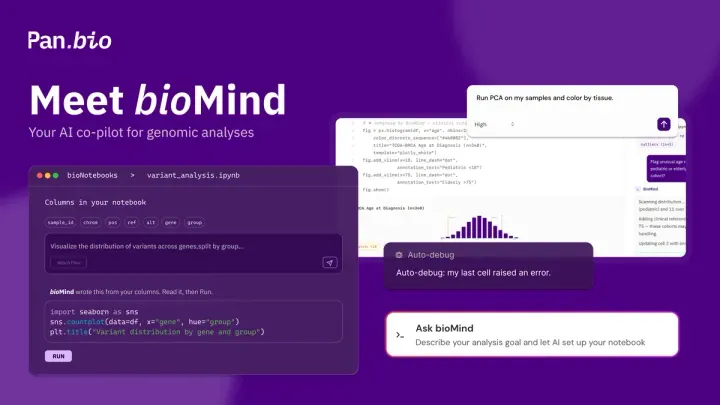
How Pan.bio answers this. We treat the model as a glass box, not a black box. bioMind shows the code and the reasoning before anything runs, and human review is part of the process rather than an optional step, including on the clinical report that comes out of an analysis or out of VAIC. You can inspect, edit, or overrule it at every point.
8. Can we reproduce an old case, and can we get our data out?
Two questions with one concern underneath: what happens later.
A case reported two years ago gets questioned. Can you re-run it with the exact pipeline version, reference build, annotation database versions and parameters used at the time, and get the same answer? Ask to see the run manifest for a completed analysis. If that record cannot be exported, the platform is a workspace rather than a system of record [3,4].
Then portability. Can you export raw data, intermediate files, variant calls, classifications with their evidence, and reports, in standard formats, on your own schedule? In a clinical lab, vendor lock-in is not a commercial irritation. It is a continuity-of-care risk.
How Pan.bio answers this. Opening an old analysis shows the stored result along with the pipeline version and the exact date and time it ran, and the output reports record every parameter, reference build and annotation database version used. Re-running is a separate action from viewing: a re-run uses whichever version you select, so selecting the original reproduces the case as it was. A run that fails partway resumes from its last completed step. Logs, parameters and report files download in their original formats, and users with the right organization permissions can download any file the platform holds.
Scoring the comparison
Weight the categories before you see the demos, not after. Deciding what matters while a salesperson is in the room is how feature lists win arguments they should lose.
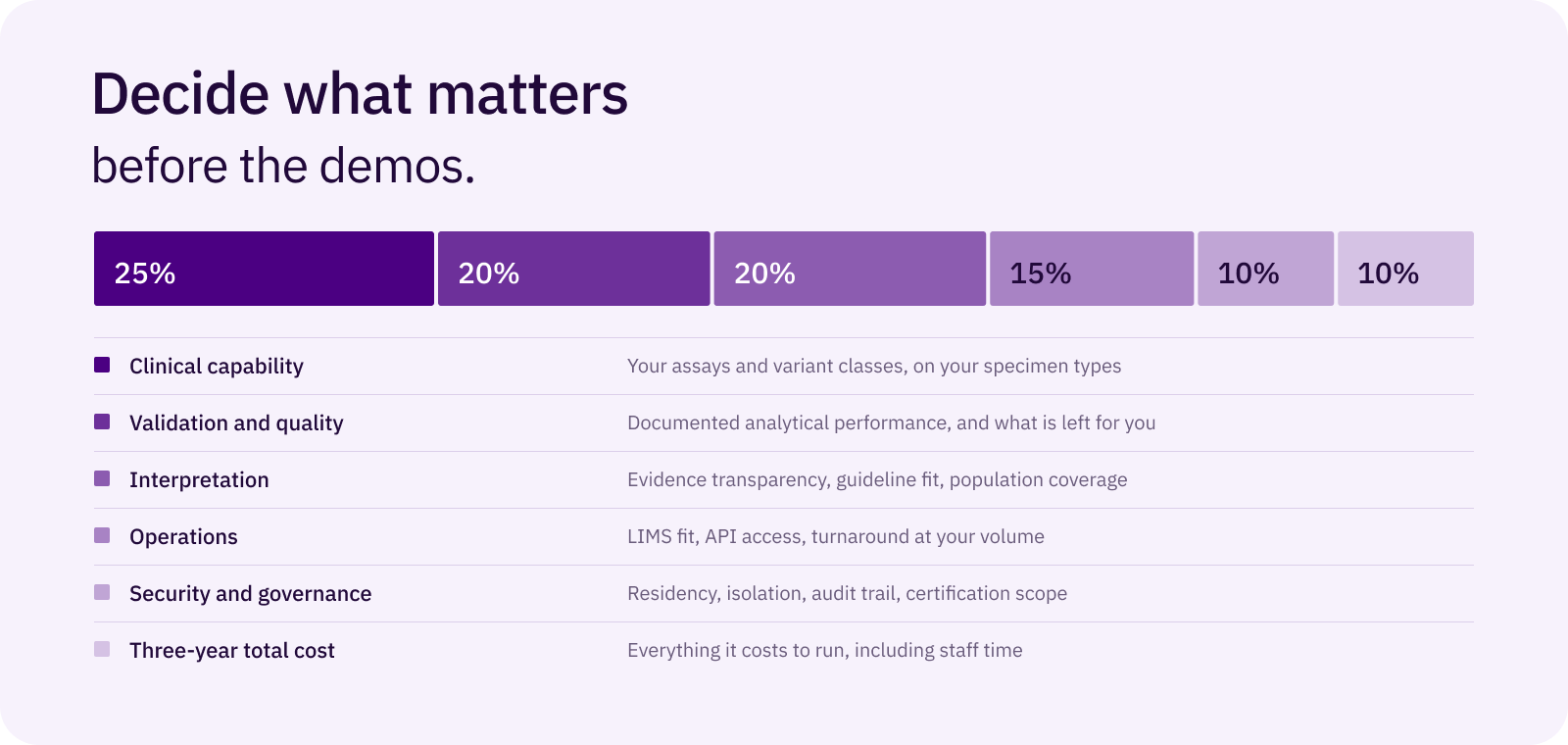
Adjust the weights to your lab. A research group should probably move weight from validation into operations, and a diagnostic lab should do the reverse.
Test your hardest case
Pan.bio is built as the end-to-end option: production workflows that run without code and are designed to support your validation rather than replace it, notebooks for the analyses that need to go off-script, guideline-aware variant interpretation, and cohort tooling for population-scale work, with the analysis, the interpretation and the audit trail living in one system rather than stitched across three.
Not a demo on our data. Bring one representative case, the one that usually goes wrong, and run it against the pipeline you use today. We will show you what the workflow automates, what stays under your scientists’ control, what bioMind proposes and what it is not permitted to do, and exactly what evidence remains auditable afterwards.
Start free, or send us the case.
References
- US Food and Drug Administration. Considerations for Design, Development, and Analytical Validation of Next Generation Sequencing-Based In Vitro Diagnostics Intended to Aid in the Diagnosis of Suspected Germline Diseases. Final guidance, April 2018.
- CCMG practice guideline: laboratory guidelines for next-generation sequencing. Journal of Medical Genetics, 2019. PMID 31300550.
- Recommendations for bioinformatics in clinical practice. Genome Medicine, 2025. doi 10.1186/s13073-025-01543-4. PMID 41107899.
- Best practice recommendations for bioinformatics approaches applied to high-throughput sequencing for rare disease and cancer diagnosis within the UK National Health Service. PMID 42055801.
- Leveraging diverse genomic data to guide equitable carrier screening: insights from gnomAD v4.1.0. American Journal of Human Genetics, 2024.
- Chen E, et al. Rates and Classification of Variants of Uncertain Significance in Hereditary Disease Genetic Testing. JAMA Network Open. 2023;6(10):e2339571.

Abdullah is a Product Manager with a strong business development focus at Pan.bio. He shapes the product roadmap in close collaboration with engineering and scientific teams, while building the partnerships and market presence that position Pan.bio at the forefront of accessible genomics and bioinformatics. With a background in pharmacy and driven by a passion for building products that make complex science usable, Abdullah is focused on advancing healthtech across the MENA region and beyond. Outside of work, Abdullah is a professional chess player and coach, with years spent deepening his own game and guiding students of all levels through theirs.
View full profile
Reproducibility in Bioinformatics Research with Bionl
This article explores the challenges and solutions to achieving reproducibility in bioinformatics research, with a special focus on how Bionl.ai can facilitate this crucial aspect.
Tasnim Nour3 minWhy Build a National Genome Project? The Strategic Imperative, Infrastructure Decisions, Clinical and Economic Returns of Sequencing Your Own Population
Why build a national genome project? The answer is where data lives. Sequencing locally closes the reference gap that others watch widen
What Is bioMind? Claude, Built Into Your Genomics Notebook
bioMind is the AI copilot in Pan.bio's Notebooks: Claude, running in your notebook. It reads your files and writes the Python and R you run, from plots to PCA.
Pan.bio Team