


What the Cells Are Saying | A Conversation with Dr. Ahmad Nabhan
From a sixth-grade classroom in Amman to a lab at UC Berkeley, Nabhan has spent a decade working out how cells send messages to each other, and what happens when cancer hijacks the conversation.

 Thikra Daraghmeh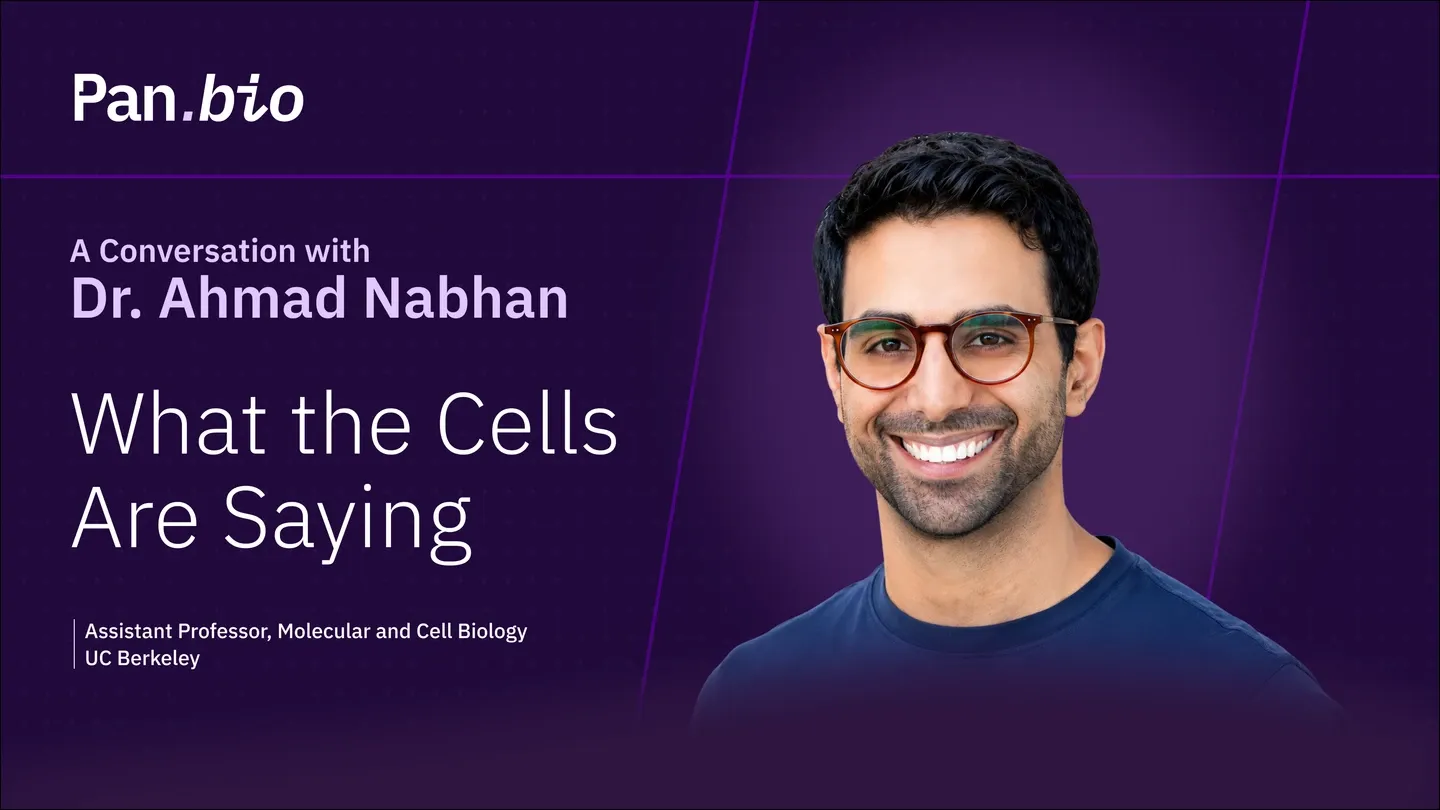
On this pageThe doctor performs. The scientist composes.
A zebrafish that loses part of its kidney rebuilds it. You lose roughly a thousand filtering units a day and rebuild none. What makes this strange is that the fish is not working with different equipment.
"The genes that let the fish rebuild the nephron are all there in the human," says Dr. Ahmad Nabhan, Assistant Professor of Molecular and Cell Biology at UC Berkeley. "They just don't turn on."
That sentence contains his entire research programme. Regeneration is not a parts problem. Every cell carries the full instruction set. The difference between a fish and a person is which cells talk to each other, in what order, and using which words. Nabhan's lab, which opened at Berkeley in January 2025, exists to decode that conversation and eventually to rewrite it.
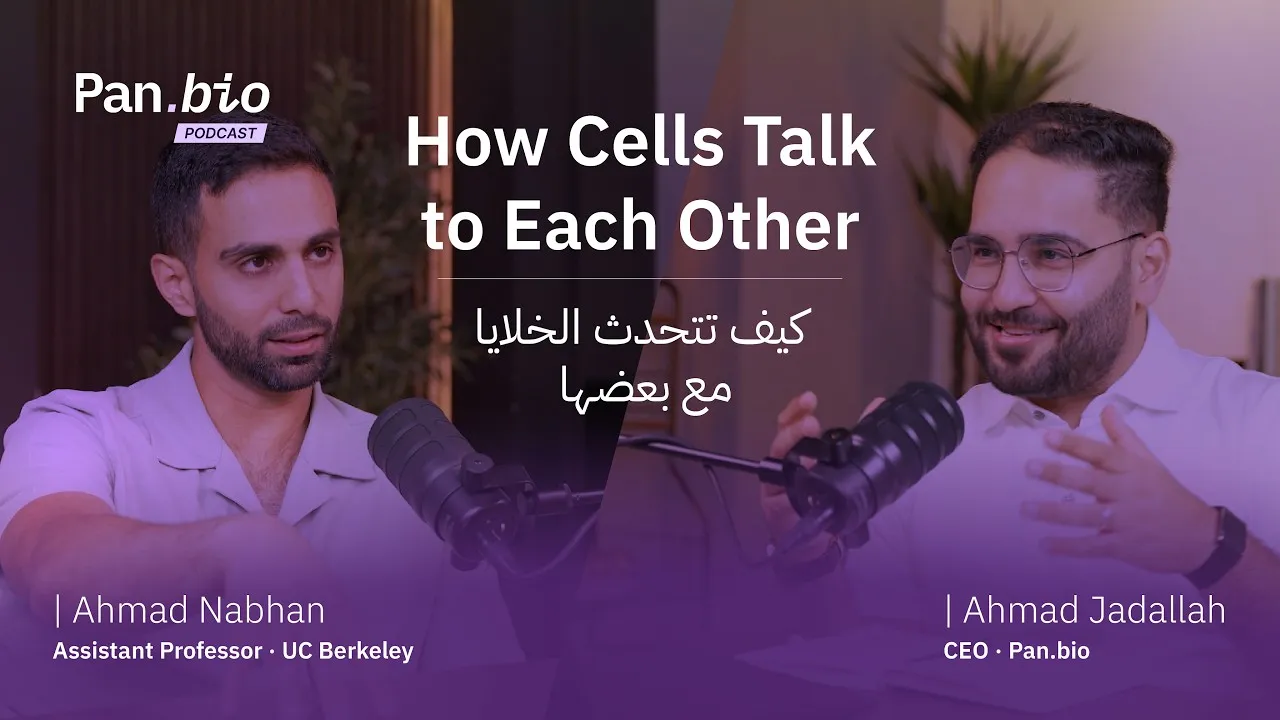
Watch the full podcast episode with Dr. Ahmad Nabhan, hosted by Pan.bio CEO Ahmad Jadallah:
The doctor performs. The scientist composes.
Nabhan was born in Amman to Palestinian parents and moved to California at twelve. He was, by his own account, not a standout student. The turn came in tenth grade, when budget cuts at the Jet Propulsion Laboratory pushed an engineer out of his job and into teaching. He arrived at Nabhan's school and taught computer science, close to unheard of at that grade level in that era. Nabhan loved it. He started doing well.
His parents had a clear preference. Computers might be a fad. Medicine would always matter. So he went to work in a clinic, this one run by a physician treating patients late in the course of HIV and cancer. He lasted two or three months. What ended it was not the suffering, though there was plenty of it. It was the shape of the job.
"The doctor is somewhat like a performer," he says. "He doesn't bring the music from inside himself. He knows the score, he's memorized it, and he has to play it the same way every time. He's not an artist. An artist can fail fifty times, and if the fifty-first works, he's written the book."
He is also specific about what emigration taught him. "At school you have an exam. Everything hangs on the exam, and once it's done, it's done. When you emigrate, you don't even know where the exam is, or what's on it. You have to find that out yourself, because your parents don't know either."
Finding the one cell that matters
He arrived at Stanford for a PhD in biochemistry when stem cell biology was still concentrated on the obvious places: blood, and the intestine, where the entire lining turns over every five days. The lung and kidney renew slowly enough that many assumed they had no resident stem cells at all.
Nabhan's doctoral work, published in Science in 2018 with Mark Krasnow and Tushar Desai [1], showed otherwise. A rare subset of alveolar type 2 cells functions as a stem cell population, and what maintains them is contact with a single fibroblast secreting Wnt. Lose the contact and the stem cell differentiates. Injure the tissue and other AT2 cells switch on Wnt themselves, recruiting more stem cells into the pool.
Clinicians found the implication exciting. In diseases where alveolar cells are lost, you would not need to transplant new cells. You could send a message to the stem cells the patient still has. Start working.
Then came the complication that reorganised the field, and Nabhan is candid that it reorganised his own thinking too. The lung holds dozens of cell types, all needing instructions, all listening on the same channels. "You can't send a signal to the alveolar stem cell without wrecking the blood vessel cells," he says. Wnt and TGF-β drugs have failed repeatedly in the clinic not because the biology was wrong but because the signalling is everywhere and the therapeutic window is vanishingly narrow.
Solving that meant studying every cell at once.
You cannot understand a country by studying its president
This is Nabhan's own analogy for single-cell RNA sequencing. "You can study the president. You'll understand why he does what he does. But you won't understand the economy, the politics, the history. You need the context."
The technology arrived at the right moment. Where profiling a cell type once required RNA from millions of cells, it became possible to sort individual cells and read which of the roughly 23,000 human genes each had switched on. Every lab was doing this in parallel, on its own organ, in isolation, until Stephen Quake at Stanford proposed the obvious consolidation: pool the effort, assign organs, build a reference atlas of the whole body. Nabhan and Kyle Travaglini took the lung.
They needed human tissue. And here the story takes a turn Nabhan tells with visible feeling.
Jim Spudich, a celebrated Stanford biochemist then around seventy, walked into the lab and asked whether they were the ones making a lung atlas. They said yes, they had done the mouse and wanted to do human.
"He said: well, I have lung cancer."
It had been caught early, a tumour about a centimetre across, and surgeons were going to remove the affected portion. Spudich offered it. If they were building a human lung atlas, he wanted the first lung to be his.
Nabhan and Travaglini stayed up until three or four in the morning designing the experiment. In the pathology cold room after surgery, they cut to specification: alveoli here, airways there, and a portion of the tumour so they could compare cancerous lung against normal. Then Nabhan spent six or seven hours at the sorter.
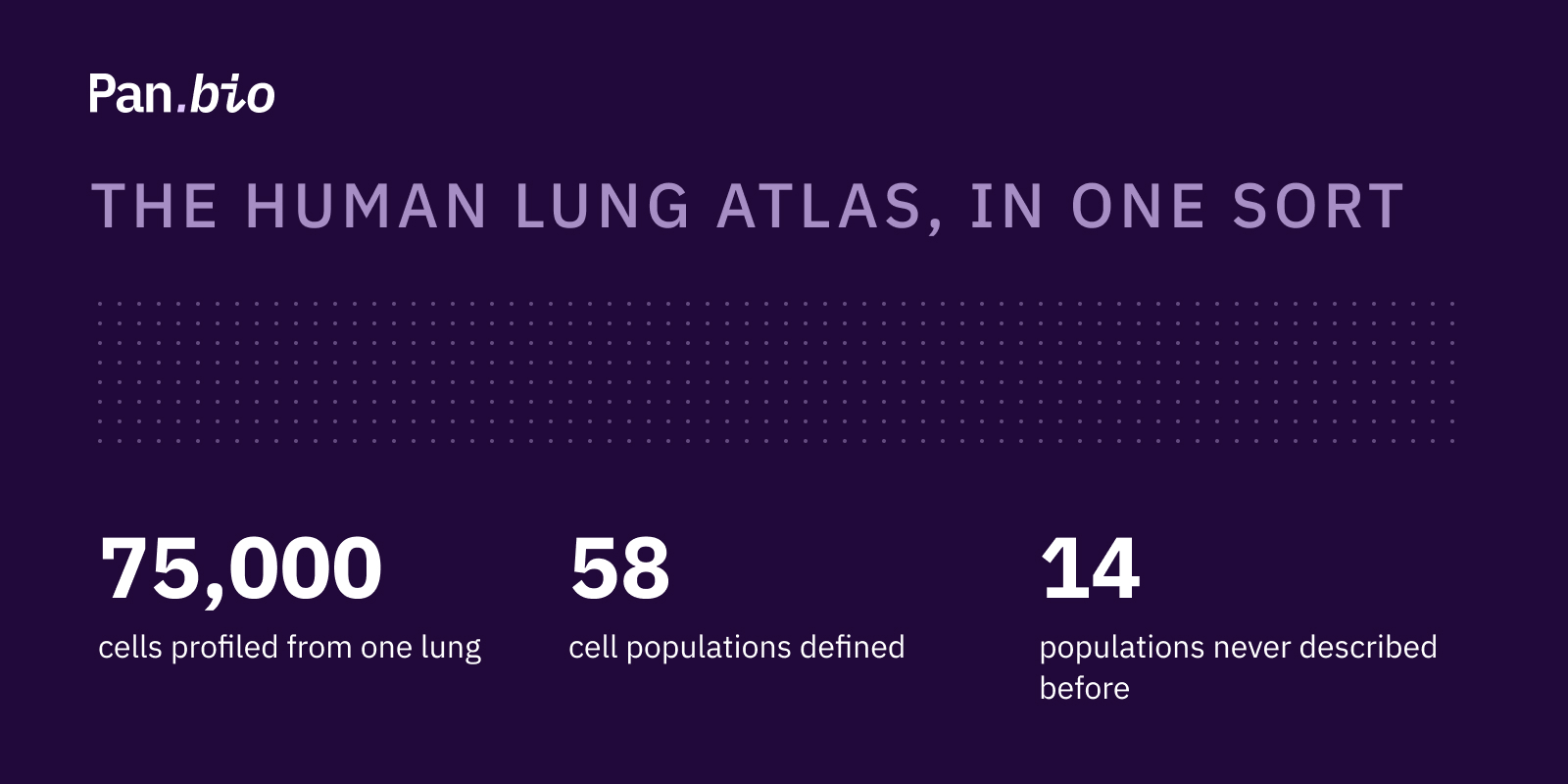
The resulting paper, in Nature in 2020 [2], profiled around 75,000 cells and defined 58 populations: 41 of 45 previously known types, plus 14 nobody had described before. The design mattered as much as the count. Sort a lung at random and you get blood cells. The team separated compartments first, then sampled within each, which is how you catch a population like the pulmonary neuroendocrine cell, which occurs at well under one in a million and yet seeds one of the most lethal cancers in the body.
The mouse comparison surfaced a quieter problem. A gene implicated in emphysema might act in fibroblasts in the mouse and in an entirely different cell type in the human. Build a therapeutic rationale on the mouse and you have built it on the wrong cell.
Letters, not words
"Cells are like people, and people are like part of a company," Nabhan says. "Everyone has a specialty, but the marketing team still has to talk to research, and research to engineering."
A gene switches on, produces a signal, and a cell carrying the matching receptor receives it. Given hundreds of cell types, you would expect hundreds of thousands of channels. There are roughly five to ten. Wnt. Ras. FGF. BMP. These same pathways, discovered largely in fruit flies, determine body plan across the animal kingdom, and nearly all are implicated in cancer.
"We used to think the messages were like words," he says. "They're closer to letters."
Which is why targeting them is hard, and what his postdoctoral work at Genentech with Vishva Dixit went after. Published in Cell in 2023 [3], it showed that different lung cell types express different Frizzled receptors: Fzd5 and Fzd6 on epithelium, Fzd4 on endothelium, Fzd1 on stroma. Fzd5 is uniquely required for alveolar stem cell activity. Using engineered Frizzled-specific agonists, the team drove targeted regeneration without the toxicity broad Wnt activation carries. It is now the organising idea of his Berkeley lab, the Wnt Code Hypothesis: cell-specific receptors are the addressing system, and the route to precision therapy in a pathway most had written off as undruggable.
Cancer does not move into the niche. It rebuilds it.
The received picture was that inflammation comes first. What Nabhan's group found is that the tumour does the remodelling itself, and deliberately.
"The cancer starts sending messages left and right. The first thing it says to the fibroblasts is: build more. So the walls thicken around the tumour like a fortress. And it switches off the immune system. It switches off every signal that says there's a problem here."
Which is a partial explanation for why immunotherapy does nothing against certain cancers. Adding immune cells does not help if the tumour has made itself invisible.
Isolating that conversation is difficult when fifty cell types speak at once, so Nabhan built a two-component organoid system reducing the room to two participants: a stem cell and its fibroblast niche. In June 2026 the work earned him a place among five scientists named Pew-Stewart Scholars for Cancer Research [4], with a four-year grant to find the signals tumours use to sculpt fibroblasts, and disrupt them.
It also reframes classification. Every cancer begins as a normal cell, so the atlas gives you the starting point and lets you ask what changed. Two lung cancers can kill on completely different timescales because the cells they came from behaved differently to begin with.
"You might have someone committing the same crime for different reasons," he says. "The way you stop him is different. What stops one cancer doesn't stop another."
A hammer looking for a nail
Nabhan is sceptical of hype cycles, and AI in biology is his current example. Not because the tools are overrated, but because their value is directional.
He uses them daily. A literature review that would have taken a month takes an afternoon. A machine learning analysis he lacked the programming background to write now takes a day, because he can specify the biological goal and get to an answer. "As long as you know the goal, it works well."
The risk sits entirely on the other side: people with excellent tooling and no grasp of the disease. "We have a hammer and we're looking for a nail, and we don't know where the nail is or what it's holding together."
Breakthroughs, he argues, will come from domain experts extending what they can already reason about, not technologists hunting for a problem to attach to a model. It is the same principle behind building tools shaped by the domain rather than pointed at it.
The problems are already here
In a PhD, Nabhan points out, the first question is: what problem are you solving? Identifying it is the hard part, and it requires living close enough to see it clearly.
"We know what the problems are," he says of the Arab world. "What we lacked was the capability."
That is what has changed. The components are present in Jordan already, the education, the talent, the large population of clinicians trained abroad. They are simply not wired together. On brain drain he is unbothered: people who leave stay attached, come back, and raise money where money is easier to raise.
On strategy he is blunt. "If you say we'll build Genentech in Amman, that won't work. You'll lose. He's been doing it for twenty years." The way in is at the base of the stack. Antibody production was once a specialized capability held by a handful of American firms. It moved to China, quality caught up, and expertise accumulated upward until the entry barrier reversed direction.
"You start with something simple, and you develop it until you're the one setting the standard."
That is the case for building genomic analysis infrastructure inside the region rather than shipping samples out of it, and the argument behind Pan.bio's platform for researchers and scientists. It runs through the rest of this series too, including our conversation with Prof. Rana Dajani on what we inherit and our analysis of why Arab populations remain missing from the reference genome.
Nabhan closes with a name. Omar Yaghi grew up in a refugee camp in Amman, moved to the US at fifteen, and in October 2025 shared the Nobel Prize in Chemistry [5]. He now holds a chair at UC Berkeley, on the same campus where Nabhan's lab opened four months earlier.
"He's not special," Nabhan says, and the point is not diminishment. "There are many people like Omar Yaghi. They just need the opportunity. And not only the opportunity to work, but to work on something that affects the whole world."
Dr. Ahmad Nabhan is Assistant Professor in the Department of Molecular and Cell Biology at UC Berkeley. His lab is currently recruiting graduate students and postdoctoral fellows.
References
- Nabhan, A.N., Brownfield, D.G., Harbury, P.B., Krasnow, M.A., Desai, T.J. (2018). Single-cell Wnt signaling niches maintain stemness of alveolar type 2 cells. Science 359(6380), 1118–1123.
- Travaglini, K.J.*, Nabhan, A.N.*, Penland, L., et al., Krasnow, M.A. (2020). A molecular cell atlas of the human lung from single-cell RNA sequencing. Nature 587(7835), 619–625.
- Nabhan, A.N.#, Webster, J.D., Adams, J.J., et al., Arron, J.R., Dixit, V.M.# (2023). Targeted alveolar regeneration with Frizzled-specific agonists. Cell 186(14), 2995–3012.e15.
- The Pew Charitable Trusts (2026). Five Pew-Stewart Scholars Selected to Advance Cancer Research.
- The Nobel Prize in Chemistry 2025. NobelPrize.org.
- Nabhan Lab, University of California, Berkeley.
- Nabhan, A.N., Biton, A., Everett, C., et al. (2026). Mapping the dialogue: Decoding alveolar stem–niche interactions. PNAS.
- Molecular and Cell Biology, UC Berkeley (2025). New Faculty Profile: Ahmad Nabhan.

Abdullah is a Product Manager with a strong business development focus at Pan.bio. He shapes the product roadmap in close collaboration with engineering and scientific teams, while building the partnerships and market presence that position Pan.bio at the forefront of accessible genomics and bioinformatics. With a background in pharmacy and driven by a passion for building products that make complex science usable, Abdullah is focused on advancing healthtech across the MENA region and beyond. Outside of work, Abdullah is a professional chess player and coach, with years spent deepening his own game and guiding students of all levels through theirs.
View full profile
The Science of What We Inherit: A Conversation with Prof. Rana Dajani
Prof. Rana Dajani led the first genome-wide association study on Middle Eastern populations and discovered the first evidence of intergenerational epigenetic inheritance of trauma.
Pan.bio Team7 minPersonalized Medicine and Bioinformatics: The Future of Healthcare
The future of healthcare lies in the convergence of personalized medicine and bioinformatics, as these rapidly advancing fields are set to revolutionize diagnostics, treatment, and disease prevention.
Abdullah Al-Atia3 minYour Genome Was Never in the Study, Only 1 in 600: Why Arab DNA Is the Biggest Blind Spot in Modern Medicine
Arab genetic architecture is its own genomic landscape, shaped by thousands of years of a unique demographic history, geographic isolation, and cultural practices that have no real parallel in the populations that dominate global genomic databases.
Ahmad Jadallah6 min